
Many hoteliers read hotel rate parity in an OTA relationship as a blanket ban on making direct booking more attractive. That assumption can remove the entire reason for a guest to choose the hotel’s website. The agreement may be narrower than the belief circulating at reception, but the only safe starting point is the wording that actually applies to your property.
This article is general information, not legal advice. Platform terms differ and change, the legal position varies by market, and your own current contract and lawyer are the authorities for your hotel.
What hotel rate parity is trying to compare
A parity provision is generally concerned with a guest seeing the same room, for the same stay, under the same conditions at a lower public price elsewhere. The important phrase is “the same conditions.” A double room with strict cancellation is not necessarily the same proposition as one that can be cancelled flexibly. A room alone is not the same product as a room packaged with parking and dinner.
That distinction is useful only when it is genuine. Renaming the identical standard room “direct special” while leaving every condition unchanged does not create a different product. Nor does hiding a compulsory charge until the last booking step make the direct rate meaningfully different. Compare the complete offer:
- room type, occupancy and dates;
- cancellation and payment conditions;
- meals and other included services;
- public availability of the offer;
- mandatory charges shown to the guest;
- benefits that are guaranteed and those subject to availability.
Run the comparison as a guest would. Open the offers for the same dates and read past the first price. If one includes breakfast and the other does not, record that difference instead of declaring an apparent undercut. If both promise the same room and conditions, treat them as like-for-like until your agreement or adviser tells you otherwise.
The purpose of this exercise is not to find a clever loophole. It is to stop managing distribution through an inaccurate summary of a contract nobody has recently read.
The rules vary, so your own agreement comes first
The legal and contractual picture is not uniform. Approaches to parity provisions differ between jurisdictions and have changed over time. Platform wording, property programmes and commercial arrangements can also change. A blog post cannot tell you what your hotel may offer today.
Keep a current copy of every distribution agreement in one controlled location. Note which entity signed it, which property it covers and when the team last reviewed the relevant commercial terms. A screenshot from a partner portal or a recollection from a former manager is not a reliable substitute.
When the wording is unclear, write down the exact proposed offer before asking for advice. “Can we give direct guests a better deal?” is too vague. A useful question sounds more like this: may the hotel offer a non-public returning-guest package that includes flexible cancellation and parking? The answer can then address a concrete product, audience and set of conditions.
Do not copy a neighbouring hotel’s practice. Its agreement, distribution mix or legal advice may be different. Equally, do not assume that an old restriction still has the same form. Check your own contract whenever you launch a new member rate, package or direct benefit, and obtain legal advice where the consequence matters.
Make the direct offer different in substance
There are several ways to create a distinct direct proposition without beginning with a lower public room-only price. Whether any particular approach is allowed under your arrangements still requires that contract check.
A closed rate can be visible only after a guest signs in, joins a genuine membership programme or receives a personal communication. It should be a real closed audience, not a supposedly private price indexed on a public page.
A package combines the stay with something else. Airport transfer, parking, dinner, a local activity or a wellness treatment can turn a bare room into a different product. The components must be described honestly, operationally deliverable and priced as one understandable offer.
Conditions can also carry value. Guests may prefer:
- a later cancellation point;
- payment at the property rather than in advance;
- a confirmed arrival window for a late journey;
- flexibility to change dates by contacting the hotel;
- a clear family-room allocation rather than an unspecified room.
Direct-only perks can include a welcome drink, parking, late check-out or an upgrade. State whether each is guaranteed. “Upgrade subject to availability” may still be pleasant, but it is not equivalent to a confirmed higher room category.
The practical discipline is to define the offer in the booking engine, reception instructions and guest message in the same way. A benefit that exists only in marketing copy becomes a complaint at arrival.
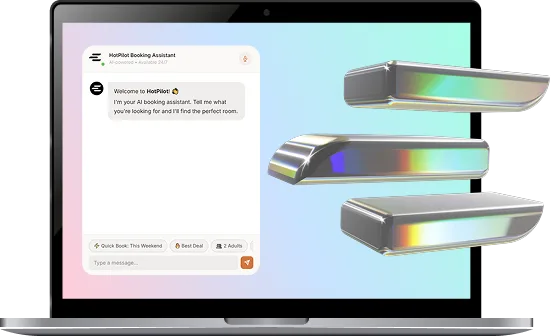
Perks, packages and member rates are all easier to run when your rate structure supports them properly. If you want to compete on value rather than headline price, it is worth seeing how those are set up.

Perks often work better than an immediate discount
Discounting is not automatically the strongest direct-booking argument. A lower public number reduces revenue on every eligible booking and teaches guests that the website’s value is simply being cheaper. The next visit starts with another search for a cut.
A relevant perk is different because its cost to the hotel can be lower than its value to the guest. An available late check-out may matter greatly to someone with an evening flight while creating little operational cost on a quiet departure day. Parking can remove uncertainty before a city arrival. A welcome drink can make the direct promise visible at check-in.
Choose benefits through operational reality, not imagination. Housekeeping should help define late check-out limits. Reception must know which bookings receive parking. Revenue staff should prevent an upgrade promise from consuming the last sellable room of a higher category.
Avoid benefits that sound generous but cannot be delivered consistently:
- an automatic upgrade when higher categories frequently sell out;
- unrestricted late departure on peak changeover days;
- “free cancellation” without a clearly stated boundary;
- a vague best-room promise that reception must interpret;
- a package component supplied by a partner who has not confirmed capacity.
The strongest perk removes a real source of friction for the guest and has a controlled marginal cost for the property. It supports the relationship without turning every direct conversation into price negotiation.
The direct advantage is ownership, not undercutting
The case for direct booking is broader than the headline rate. The hotel receives the reservation through its own route, holds the permitted contact relationship and can help the guest without placing every change through an intermediary.
That matters before arrival. A family can clarify bed configuration. Reception can explain parking or arrange a late arrival. The hotel can send accurate directions and prepare for an accessibility request. With appropriate consent, the relationship can continue after the stay rather than disappearing into a platform account.
It also matters commercially. Distribution has a cost, and direct acquisition has a cost too: website, booking technology, payment processing, support and marketing. Compare those costs honestly. “Direct is free” is no more useful than “OTA bookings are bad.” Platforms can provide reach and demand; the direct channel gives the property more control over the experience and relationship.
This is where rate rules and hotel pricing should support a defined channel strategy. Decide which inventory and conditions belong in each offer, keep availability accurate and give the direct guest a reason to complete the booking without creating a public race to the bottom.
Check before you launch, then check the live journey
Turn contract review into a short release checklist. For each proposed offer, identify the audience, room, dates, conditions, inclusions, displayed price and sales channel. Compare it with the live OTA product, not with an internal rate name.
Then ask three questions:
- Does our current agreement address this type of offer or audience?
- Is the distinction visible and understandable to the guest?
- Can operations deliver every included condition and perk?
If the first answer is uncertain, ask the platform through the appropriate channel or consult your lawyer. Assuming prohibition can cost legitimate direct business. Assuming permission can create a contractual dispute. Both mistakes begin with treating hearsay as policy.
After publication, make a test search and booking on mobile. Check that the package is not accidentally exposed as a lower room-only rate, that fees appear at the right point and that the confirmation names the benefits. Give reception a simple way to recognise the booking.
Review the comparison when a contract, public offer or operating condition changes. Parity is not a one-time legal memo; it is a recurring distribution check attached to real products.
Let’s sum up!
- Rate parity concerns comparable offers, so room, conditions, inclusions and audience all matter.
- The legal and contractual position varies and changes; your current agreement and lawyer remain the authority.
- Closed offers, genuine packages, different conditions and direct perks may create distinct value, subject to your own terms.
- A useful perk can cost less than a blanket discount and avoids training guests to wait for a lower price.
- Direct booking matters because the hotel owns more of the relationship and experience, not merely because it can undercut.
- Every offer should pass a contract, guest-clarity and operational-delivery check before launch.
If you would like to compete on value rather than headline price, book a HotPilot demo and we will go through how member rates, packages and direct perks are set up.