
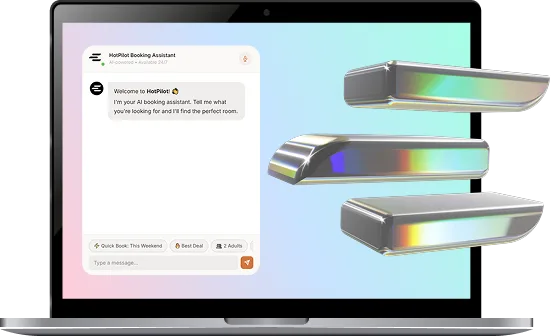

Every guest has a story. For the first time, you can actually know it — and act on it in real time.
There is a paradox at the heart of modern hotel marketing. The industry spends enormous energy competing for new bookings — on OTAs, in paid search, through metasearch engines — while quietly ignoring one of the most powerful revenue levers it already controls: the guests who have already stayed.
Acquisition is expensive. Retention is undervalued. And for most independent hotels and boutique accommodation providers, the gap between these two realities quietly drains margin every single quarter.
But something has changed. The AI era hasn’t just made automation cheaper — it has made individualisation at scale genuinely possible for the first time. What was once the exclusive territory of luxury brands with seven-figure CRM budgets and dedicated loyalty teams is now accessible to a forty-room boutique hotel in Athens, a family-run agritourism in the Bulgarian Rhodopes, or a villa complex on the Turkish islands.
The argument of this article is simple: retention marketing has become the highest-ROI channel available to hospitality businesses, and AI-powered platforms like HotPilot have made it possible for any property to execute it with the precision of an enterprise. Here’s how.
1. Know Your Guest Before They Place a Reservation
Most hotels have a guest data problem. Not a lack-of-data problem — a scattered-data problem. Information about a future guest’s intent, origin, and behaviour exists long before they ever click “Book now.” The question is whether your platform can capture and interpret it.
This is where pre-booking intelligence changes the game entirely.
Attribution: Follow the Path, Not Just the Click
Traditional booking analytics tell you where a conversion happened. Smart attribution tells you the full journey that led to it: which channel first introduced the guest to your property, what content they consumed, how many sessions it took, which rate triggered the final decision.
HotPilot’s multi-touch attribution model tracks the complete pre-booking path across organic search, paid campaigns, metasearch, social, and direct. This matters because a guest who discovered your hotel through an Instagram story about your breakfast terrace, researched you on Google, compared you on a metasearch engine, then booked directly is not the same guest as one who arrived cold from a last-minute OTA deal. They have different motivations, different price sensitivities, and different retention potential.
When you know which story brought them to you, you can continue telling it.
Behavioural Signals Before the Booking Window
Pre-booking intelligence goes beyond attribution. HotPilot’s booking engine captures anonymised behavioural signals from site visitors: which room categories they explored, which dates they tested, whether they engaged with the dining or wellness sections, how long they spent on specific offers. Combined with geographic and device signals, this builds a probabilistic profile of intent before any personal data is even collected.
For returning visitors, this profile merges with historical stay data to create a true guest intelligence layer. By the time a returning guest starts a new session, the system already knows their likely preferences, their last stay patterns, and even the moments in their previous journey when they hesitated or abandoned.
“HotPilot doesn’t wait for a booking to start understanding a guest. It starts building that understanding the moment they arrive on your site.”
Conversational Pre-Booking as a Data Source
HotPilot’s conversational booking engine adds a layer that no traditional booking widget can match: natural-language interaction data. When a prospective guest asks “Do you have a room with a sea view and a bathtub for our anniversary?” they are volunteering not just a preference, but an occasion, an emotional context, and a set of priorities that should shape every communication that follows.
These conversational signals are structured, stored, and fed into the guest profile — informing everything from the confirmation email to the upsell offer sent three weeks before arrival, to the post-stay message that references their experience by name.
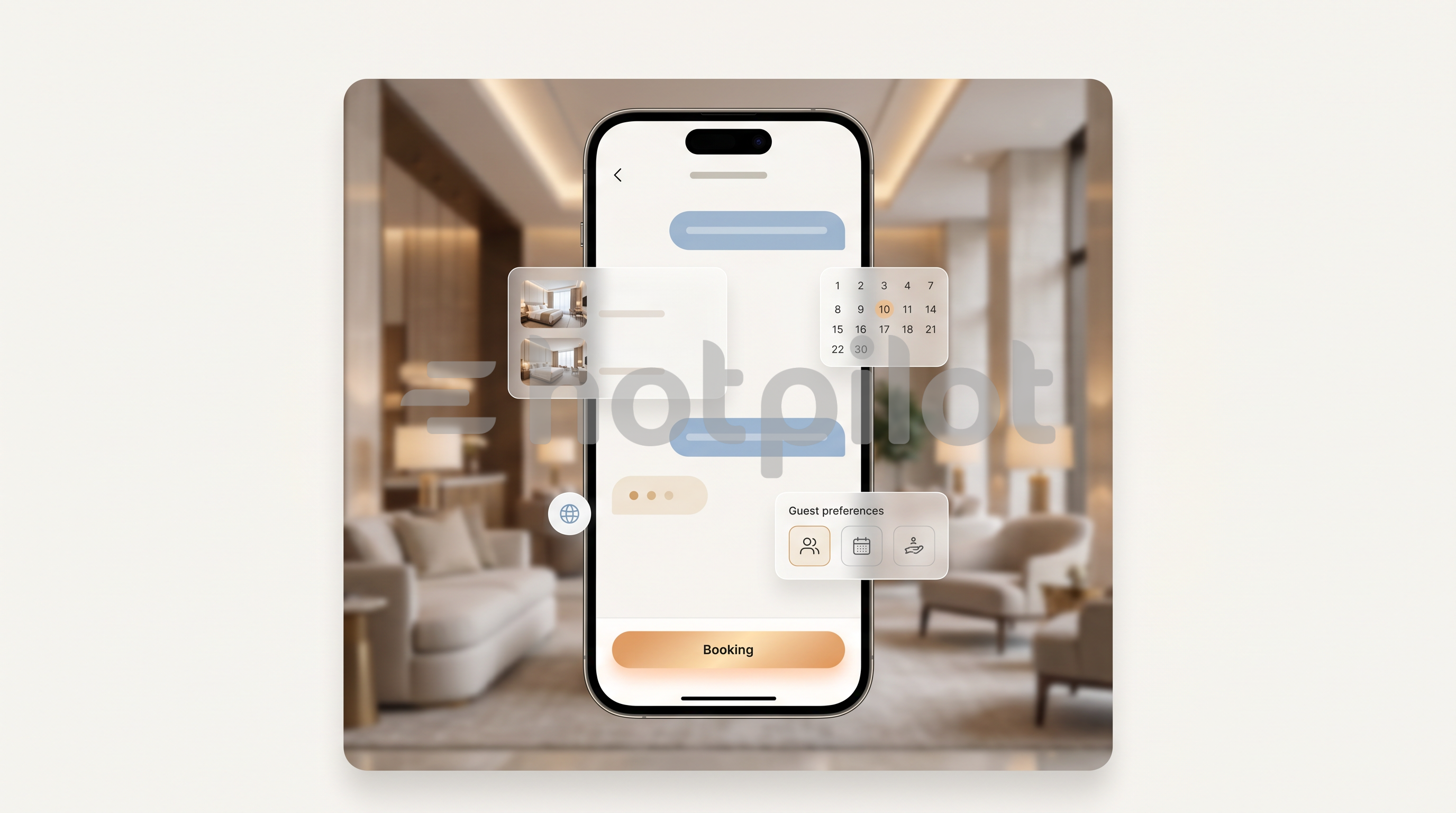


2. Segmentation That Means Something
The word “segmentation” has been in hotel marketing vocabularies for decades. In practice, it usually means dividing guests into three buckets: leisure, business, and groups. Sometimes a fourth: loyalty programme members. This is not segmentation — it’s a broad categorisation that obscures more than it reveals.
Meaningful segmentation in the AI era operates across multiple simultaneous dimensions: behavioural, transactional, attitudinal, and predictive.
Behavioural Segments
How does this guest actually behave? Are they a direct-booker or an OTA-first guest you’ve managed to convert? Do they book far in advance or make impulsive last-minute decisions? Do they engage with pre-arrival communication or ignore it? Do they respond to value-framed offers or experience-led ones?
HotPilot’s analytics layer tracks these behavioural patterns across the full booking and stay lifecycle, surfacing clusters of guests who share similar patterns without requiring manual rule-setting.
Transactional & Revenue Segments
Beyond behaviour, transactional segmentation captures the economic relationship with each guest. Average daily rate, total spend per visit (including F&B, spa, extras), booking lead time, cancellation rate, upgrade acceptance rate — these signals combine into a guest lifetime value model that makes it possible to identify your highest-value cohorts and protect them with disproportionate attention.
A guest who books your standard room at a modest rate but consistently spends 40% of their total visit on in-house dining, spa, and experiences is far more valuable than their room rate suggests. Retention strategy for this guest looks very different from one designed for a high-ADR booker who eats breakfast off-site and never touches ancillary revenue.
Occasion and Intent Segments
One of the most powerful — and most underused — segmentation dimensions is occasion. Why is this guest here? Anniversary, family holiday, remote work escape, solo adventure, business trip with a day trip appended? Occasion shapes what they want, what they’ll spend on, and how they’ll remember the stay.
HotPilot captures occasion signals from the conversational booking engine, from declared preferences, and from behavioural patterns (families with young children browse differently than couples celebrating anniversaries). These signals are used to personalise everything from welcome messaging to the timing and framing of upsell offers.
Predictive Segments: Who Is About to Come Back?
Perhaps the most commercially important segment is one that doesn’t exist in your current guest list: guests who are highly likely to rebook — if you reach them at the right moment, with the right message.
HotPilot’s predictive segmentation models analyse historical rebooking patterns, seasonal preferences, time-since-last-visit decay curves, and engagement signals to score every past guest on their rebooking probability. This allows marketing resources to be concentrated on the segment where they will generate the highest return.
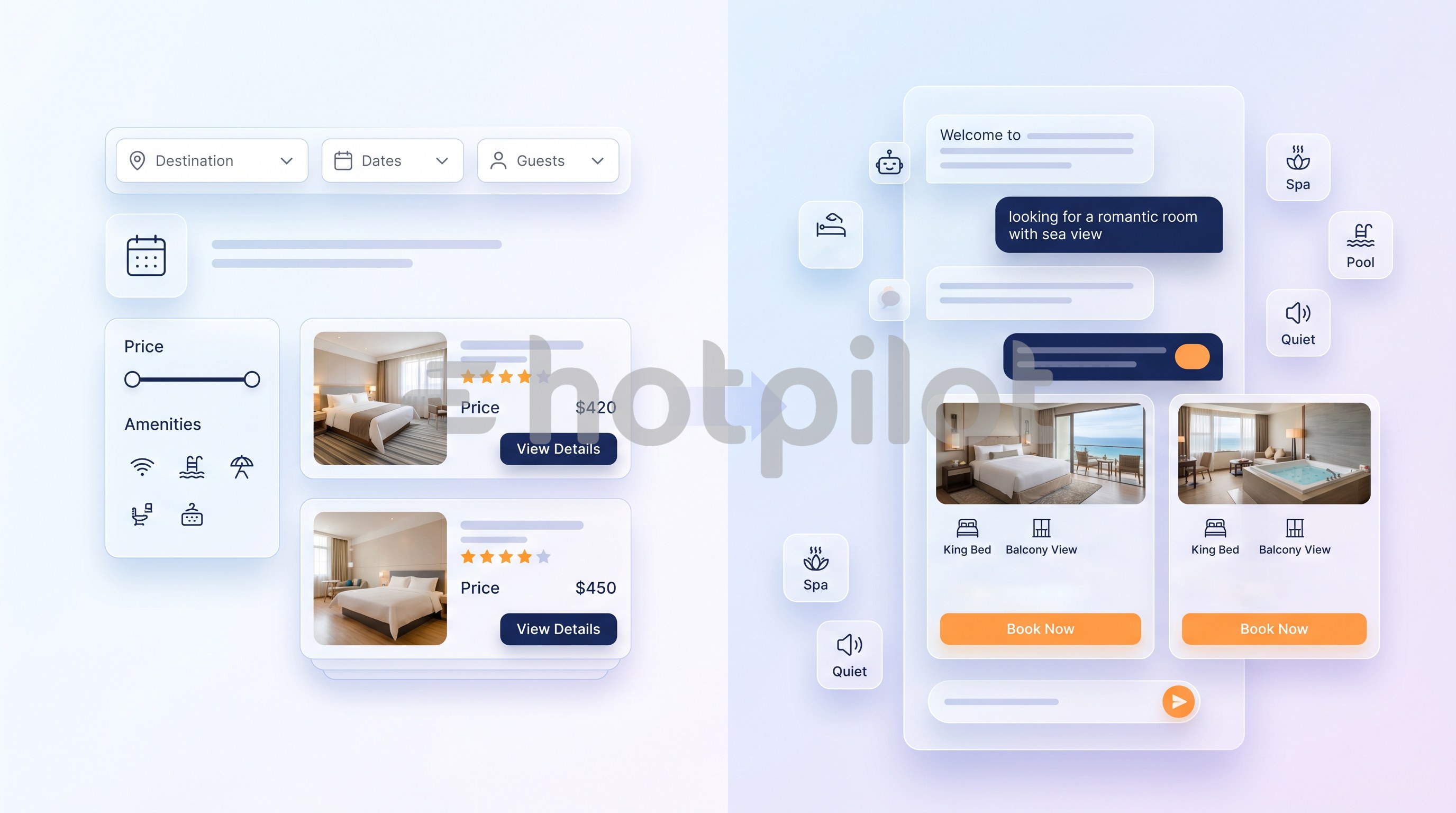

3. The Platform That Unifies the Signal and Feeds the Right Intelligence
The reason most hotels never achieve genuine retention marketing is not lack of intent — it’s fragmentation. PMS data sits in one system. Booking engine data in another. Email marketing in a third. Social and paid analytics in a fourth. The conversational interactions that are now generating some of the richest intent signals? Nowhere, because the booking widget doesn’t record them.
The result is that the average hotel marketer makes decisions about guest communication with access to maybe 20% of the data that exists about that guest’s relationship with the property.
A Unified Guest Intelligence Layer
HotPilot is designed from the ground up as a data-unified platform. Every touchpoint in the guest journey — pre-booking sessions, conversational interactions, PMS stay records, ancillary transactions, email engagement, post-stay reviews, repeat visit patterns — is consolidated into a single guest intelligence layer.
This is not a CRM in the traditional sense. It is a continuously updated, AI-enriched guest profile that grows richer with every interaction. The profile is not static history — it is a living model of who this guest is, what they value, and what they are likely to do next.
Feeding the Right AI Models
Unified data is necessary but not sufficient. The value comes from applying the right analytical intelligence to each decision. HotPilot connects this unified layer to purpose-built AI models for specific tasks:
• Revenue optimisation models that factor in guest-level price sensitivity alongside property-level demand signals, moving beyond generic yield management.
• Communication personalisation models that determine not just what message to send, but which tone, format, and value proposition will resonate with this specific guest segment.
• Churn prediction models that identify at-risk guests before they defect to a competitor, triggering proactive re-engagement.
• Upsell propensity models that predict which guests are likely to accept which ancillary offers at which point in the pre-arrival journey.
The important distinction is that these models are not generic hospitality AI — they are grounded in your property’s own data. A pattern that works for a city hotel in Bucharest will not be the same as one that works for a coastal resort in Halkidiki. HotPilot’s intelligence layer learns your specific property’s rhythms, and its recommendations reflect that specificity.
“The platform should be invisible. What the hotelier experiences is not a data system — it is a property that seems to know its guests unusually well.”
This is Part 1 of a two-part series on AI-powered retention marketing for hotels. In Part 2, we go deeper into execution: the marketing automation logic that operates on momentum rather than scheduled triggers, the analytics layer that surfaces what is actually driving — and quietly destroying — guest loyalty, and the compounding data advantage that makes starting now more valuable than starting later.


