


If you have under 100 rooms, you almost certainly do not have a full-time revenue manager. You also cannot afford to leave rates flat for a year. Dynamic pricing is the gap between losing 8% of revenue you could have earned and capturing it without taking on a salary. This is what good dynamic pricing actually looks like at independent-hotel scale, what signals matter, and where you should still trust your gut over any algorithm.
What dynamic pricing actually is
The cliché version is “raise prices when busy, lower when quiet”. The real version is more disciplined: a forecast of demand for every date in the next 365 days, refreshed every few hours, with rates that move within bands you define.
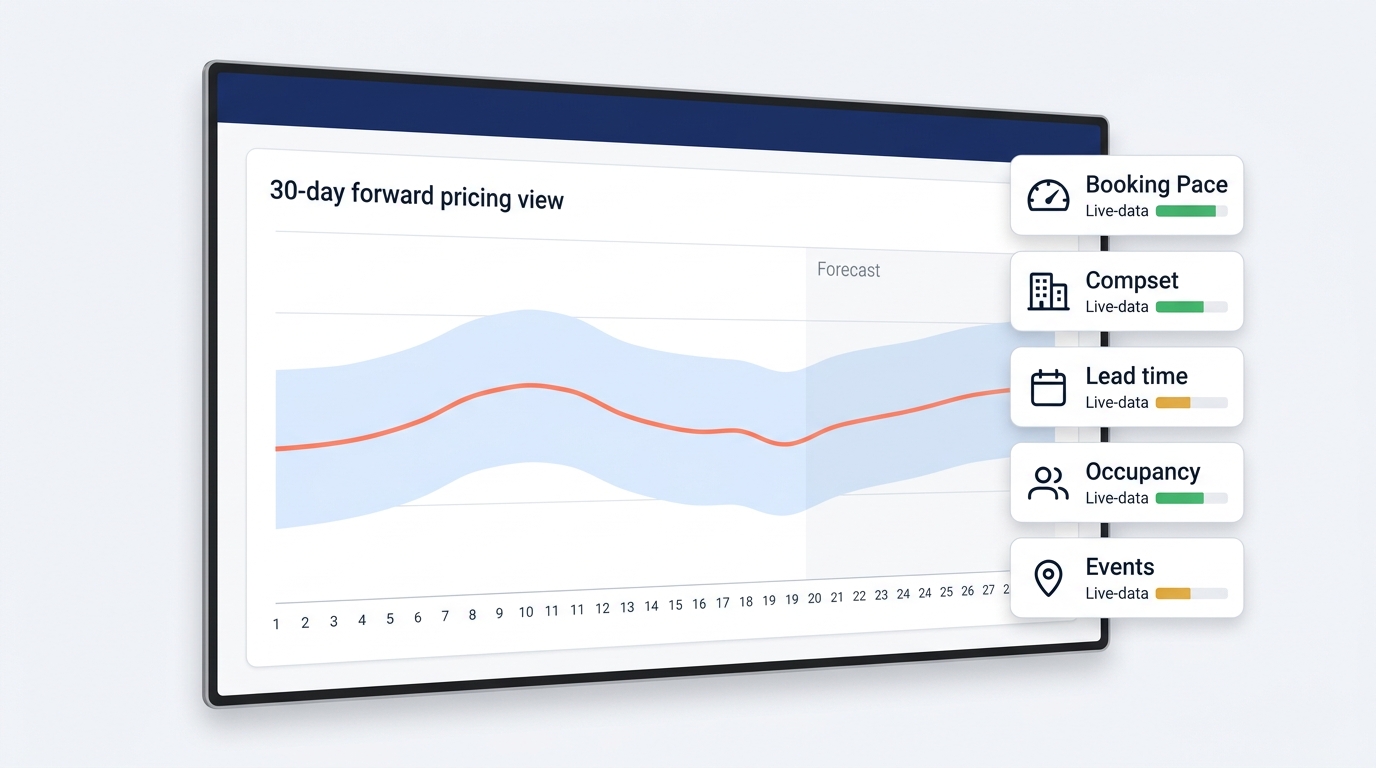
A serious dynamic-pricing system looks at:
Booking pace — are you ahead or behind last year for the same arrival date.
Occupancy projection — what percent of rooms are forecasted to sell by check-in.
Comp-set rates — what three to five similar hotels nearby are quoting today for the same night.
Lead time — how far out the typical guest is booking.
Events — concerts, conferences, sport — that shift demand without warning.
A small operator does not have to assemble all five signals manually. Modern pricing tools surface them, but you should understand them so you can challenge a recommendation that looks wrong.
The signals that matter most for small properties
If you can only watch two signals, watch booking pace and comp-set rates.
Booking pace is the most honest demand signal you have. If you are 30% ahead of last year’s pace for August arrivals on the first of June, you can almost certainly hold higher rates than last year. If you are 20% behind, no amount of price-cutting recovers that gap, and the cut just trains your guests to wait.
Comp-set rates matter because they set the ceiling. You can hold parity with the OTA channel but you cannot price above the property next door without a clear quality differentiator. The signal is not “match them”, it is “stay aware of them” — when the comp set jumps €30 the day before a wedding weekend, you should jump too.
The traps to avoid
1. Racing to the bottom
If you cut rates the moment occupancy lags, you train guests to wait for a discount. Within a season they learn the pattern and stop booking in advance. The system unwinds itself.
2. Treating midweek and weekends the same
Midweek demand is a different curve from weekend demand. Pricing them with one model averages both badly. Almost every independent hotel under-prices Saturdays and over-prices Tuesdays.
3. Ignoring restrictions
Minimum-stay rules are a pricing tool. Closing arrival on a Friday for a wedding weekend block is a pricing decision. The ADR you achieve depends on which guests you let in, not just on the headline rate.
4. Letting the algorithm publish without a sanity check
Every revenue-management tool has at least one weird quarter where it recommends a €40 rate on a Saturday because of a stale event feed. A daily five-minute review catches it.
When to override the algorithm
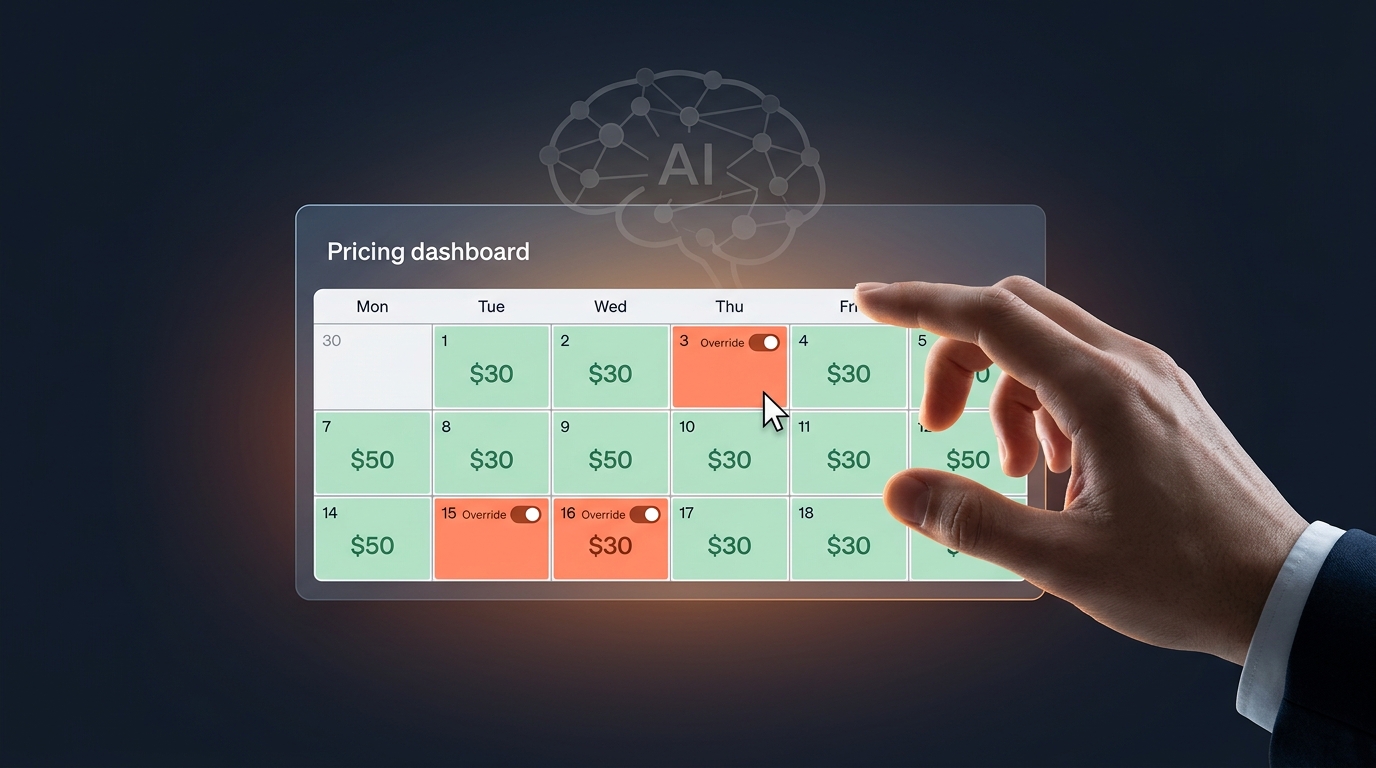
There is a misconception that automated pricing means “set and forget”. That is wrong. The right model is: the system handles the 95% of dates that follow normal patterns, and the human handles the 5% that the system has no way of knowing.
Override cases:
A large local event that is not on any feed yet (you heard about it at coffee).
A maintenance closure on specific room types.
A negotiated group block that consumes inventory off-system.
A reputation event — newspaper review, news cycle — that will move demand in a direction the system cannot see.
Block out ten minutes every morning. Look at the next 14 days, check what the system did, override anywhere you have a signal the system does not.
Measuring success: ADR vs RevPAR
ADR (average daily rate) only tells you how high you priced. RevPAR (revenue per available room) tells you how high you priced and whether you actually filled the rooms. RevPAR is the metric.
A property that holds €180 ADR at 50% occupancy underperforms one that holds €140 ADR at 75% — €90 RevPAR vs €105 RevPAR. The cheaper hotel made 17% more revenue.
If your pricing tool only reports ADR, you are missing the only number that matters.
Let's sum up!
Dynamic pricing is rate bands tied to a real demand forecast, not “raise prices when busy”.
Two signals matter most at small-property scale: booking pace and comp-set rates.
Avoid the four traps: rate races, midweek-equals-weekend, ignored restrictions, no sanity check.
The human handles the 5% of dates the system cannot know about. The system handles the rest.
Measure on RevPAR, not ADR. The cheaper hotel (depending on its price niche) often wins the year.
HotPilot’s price monitor watches your comp set and your booking pace and surfaces overrides daily. Try it at hotpilot.ai.