
The hardest-working person in your hotel spends hours a week on work a machine could do better — and none of it is what they're best at.
Ask any hotelier what they'd do with an extra day a week and the answer comes fast. The reason they don't have it, though, is rarely dramatic. It isn't one big problem. It's a hundred small, repetitive tasks that quietly fill the calendar — the same guest questions, the same reports, the same messages, the same copy-paste, over and over.
This is the part of running a hotel nobody advertises: the invisible admin shift that wraps around the “real” work. AI automation won't run your property for you, and anyone promising that is selling something. But it can absorb a surprising amount of that repetitive load — realistically around fifteen hours a week — and hand the time back to the person who should be spending it on guests, not on their inbox.
Where the Hours Go
The work that drains an operator's week rarely shows up on any org chart. It's answering the same pre-arrival questions — what time is check-in, is there parking, can we leave our bags. It's chasing and replying to reviews. It's rekeying numbers between the PMS and a spreadsheet. It's reconciling availability across four OTAs. It's sending the same confirmation, the same pre-stay note, the same post-stay thank-you. It's pulling the figures for the morning check.
None of it is hard. All of it is necessary. And together it adds up to a part-time job nobody was ever hired for. The problem was never the difficulty — it's the volume and the relentless repetition. That's exactly the kind of work machines are good at and people quietly resent.
Add it up honestly and the tally is sobering: a few hours a week on guest messages, a couple more drafting review replies, another block assembling reports and reconciling channels, and a steady drip lost every time you switch between tools to find a single number. Individually, each is trivial. Collectively, it's most of a working day, every week, disappearing into work that never needed your judgement.
The Test for What to Automate
Not everything should be automated, and pretending otherwise is how hotels end up with cold, robotic guest experiences. The useful filter is simple: automate the tasks that are repetitive, rules-based, and low-judgment — and keep a human on everything that needs warmth, discretion, or a decision.
“What time is check-in?” has one correct answer and does not need a person at two in the morning. A guest whose anniversary dinner just fell through does. The goal isn't to remove people from the work. It's to stop spending people on the work that never needed them in the first place.
The tasks that eat your week aren't the ones that need you — they're the ones you've never had time to hand off.
The Front Desk That Never Sleeps
The single biggest time sink in most properties is guest communication, and it's also the easiest thing to hand off well. A large share of the messages you answer are variations on the same two dozen questions. An AI assistant can handle them instantly, in the guest's own language, at any hour — and escalate only the ones that genuinely need you.
Pre-arrival details, directions, check-in instructions, a well-timed upsell, the post-stay thank-you: the messages you'd send anyway, sent automatically and consistently. The guest gets a faster, clearer answer than a stretched team could give at 11 p.m. You get your evening back. Nobody loses except the backlog.
And the saved time quietly earns its keep twice. A traveller who asks a question at midnight and gets an instant, confident answer is far more likely to book direct than one left waiting until morning, by which point they've often booked elsewhere. Faster replies don't just clear your inbox; they convert. The hours you reclaim and the bookings you capture come from the same automation.
The Admin That Quietly Does Itself
Beyond the inbox, a second layer of hours hides in the back office. Instead of assembling occupancy, pickup, and channel performance by hand, the morning report builds itself and is waiting when you open your laptop. And keeping availability in sync across your channels — the endless, error-prone reconciliation that causes overbookings — becomes something you supervise rather than something you perform.
What the 15 Hours Are Actually For
Here's the part that matters. The point of saving fifteen hours a week isn't a leaner rota or a cut role. It's moving human time to where humans actually create value.
A freed-up operator can answer the phone warmly instead of letting it ring out. Walk the floor. Fix the recurring problem instead of firefighting it for the tenth time. Chase the corporate account that's been sitting in the “later” pile. Or simply go home at a reasonable hour, which is its own kind of retention strategy. Every industry that automated its repetitive admin didn't shrink — it redirected. Hospitality is a people business, and the real promise of automation is more time for people, not less of them.
Automation That Keeps You in Control
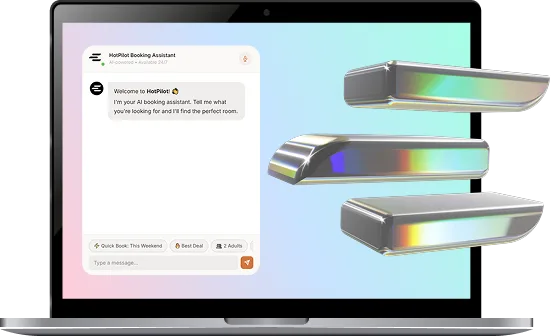
This is how HotPilot approaches it: not a black box that quietly takes over, but a set of tools that handle the repetitive layer — guest messaging, reporting, channel sync — while keeping you in the loop on anything that needs a human call. You decide what runs on its own and what comes to you. The result isn't a hotel with fewer people. It's a hotel where the people spend their hours on the things only people can do.
You didn't get into hospitality to answer the same email for the thousandth time. The work that made you fall for it in the first place is still there. Automation just gives you back the hours to get to it.
About HotPilot
HotPilot is a next-generation hotel booking and property management platform built for conversion, retention, and intelligent growth. Combining conversational commerce, AI-powered analytics, and automated marketing tools, HotPilot gives accommodation providers of all sizes the infrastructure to compete and win in the modern travel landscape.