

Reviews are the most under-used asset in hospitality marketing. A hotel might have 1,200 four-and-five-star reviews scattered across Google, Booking, Tripadvisor and Airbnb — and not one of them on its own website above the fold. Meanwhile every guest who hesitates on the booking page opens a new tab and reads someone else’s reviews instead of yours. This article is about closing that loop: one inbox to monitor everything, one workflow to reply, and one component on your direct site that converts.
The reputation gap that costs you direct bookings
Picture the journey. A guest lands on your homepage from a Google search. The page is beautiful. The rates look fair. They click “book”. And then, because they have never stayed with you before, they pause and check social proof. Where do they check?
They open a new tab and read Tripadvisor or Google Maps reviews.
They open a third tab and check Booking — and now they are inside Booking’s funnel, not yours.
They land back on your site, but their attention is split, and most of them never finish.
You did the marketing work. Booking.com closed the booking. You paid 18% for it. The fix is not to “get more reviews”. You already have them. The fix is to put them where guests actually decide.
Step one: one inbox for everything
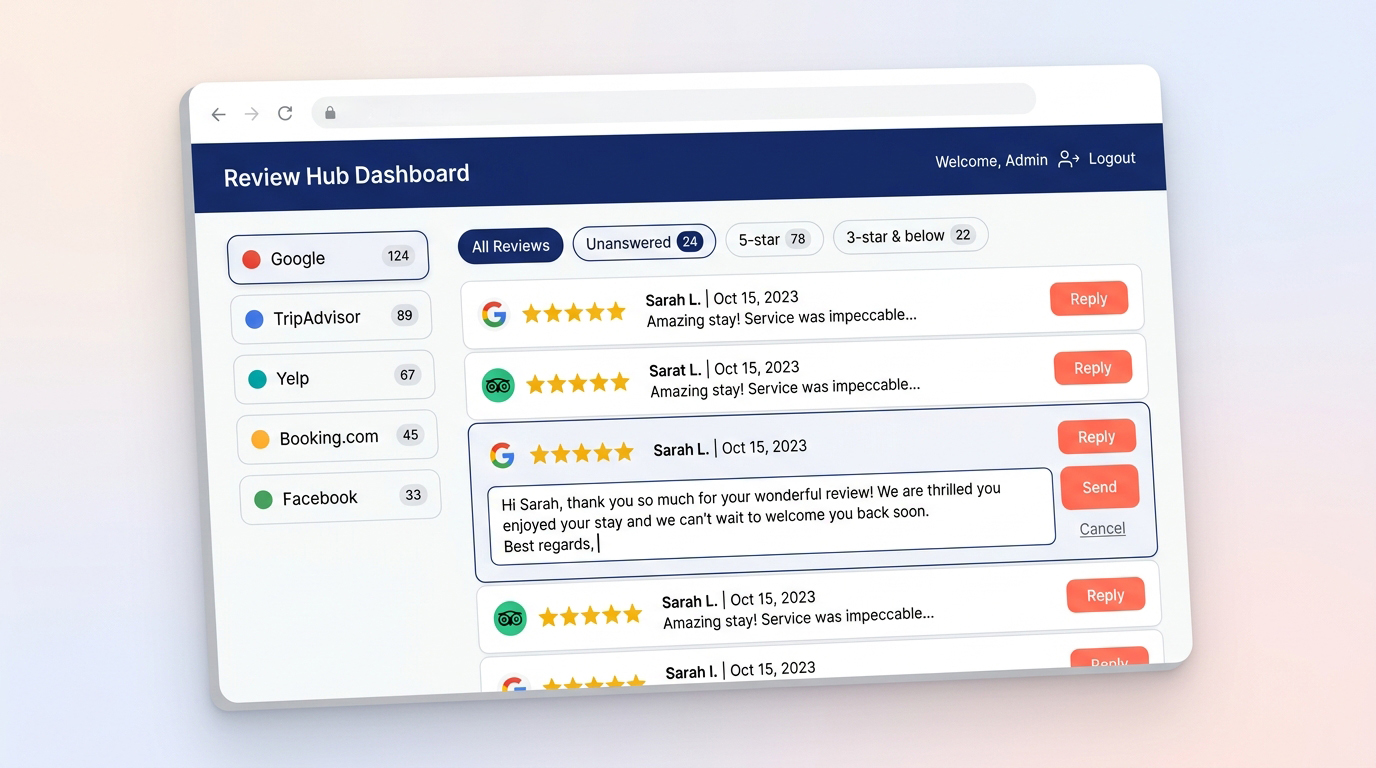
Most independent hotels manage reviews by logging into each platform every Monday morning. That works for the first six months and then breaks because nobody has time. The first move is consolidation:
Pull every review from every platform you sell on into a single dashboard.
Filter by source, rating, language, and date.
See where you have an outstanding reply and where the conversation is finished.
The work goes from “log into five platforms and skim” to “open one tab and triage in fifteen minutes”. That is the difference between a hotel that responds to 90% of its reviews and one that drifts to 30%.
Step two: reply with intent, not script
There is a temptation to reply to every review with the same template. Resist it. Templated replies hurt you in two ways: they signal that nobody read the actual review, and Google now demotes reply patterns that look automated.
A good reply is short (two to four sentences), names something specific the guest wrote about, and either thanks them sincerely for a five-star or addresses a concrete fix for a three-star. The goal is not just to make the reviewer feel heard; it is to show the next prospect, scrolling reviews, that you actually care.
For Booking, Tripadvisor and Airbnb the reply happens on the platform. For Google it can happen via API directly from your inbox — a small but meaningful workflow improvement.
Step three: put your best reviews on your own site
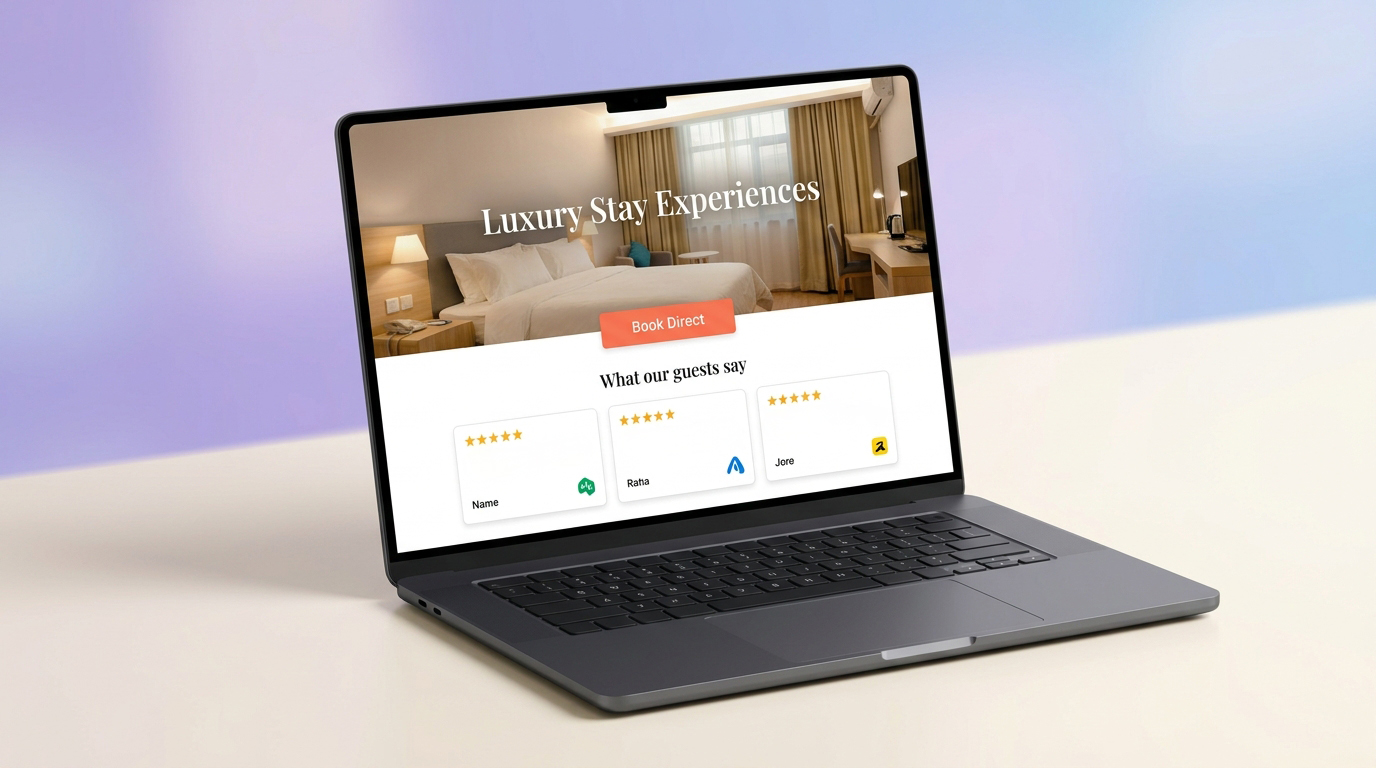
This is the step almost no independent hotel does well. Pick your eight to twelve strongest reviews — ideally a mix of sources so the social proof feels organic — and put them on:
The homepage, above the fold.
The booking page, near the rate.
The room-detail pages, tied to the room the guest mentioned.
The reviews must show the source badge (Google, Booking, Tripadvisor). Without it, prospects subconsciously read them as testimonials you wrote yourself. With the badge, they read them as social proof.
A clean reviews section on a direct site reliably lifts conversion 0.3–0.7 percentage points. On a property doing 2,000 direct sessions a month at €120 ADR, that is €7,000–€16,000 per year of recovered revenue from work you already did when you collected the reviews.
A note on compliance
You cannot copy a Booking review onto your homepage verbatim without attribution. Tripadvisor has stricter rules. The right pattern is:
Show the rating summary and a short excerpt.
Link back to the original review.
Always show the source badge.
Where rights are unclear, default to showing a star-rating summary and a link, not the full text.
What to remember
Reviews are the under-used asset that closes the gap between “interested” and “booked”.
Consolidate every platform into one inbox so reply rate does not drift to 30%.
Replies should be short, specific, and human — templates are visible from a mile away.
Put your strongest reviews on your homepage, booking page, and room pages with source badges visible.
Respect each platform’s rights — show summaries and links where displaying full text is not allowed.
HotPilot’s Review Hub gives you the unified inbox plus a ready-made website component that displays your highlighted reviews with the right attribution. Start your trial at hotpilot.ai.