

If you run a 30–80 room hotel and you are still updating rates in seven extranets every Sunday night, this article is for you. A real channel manager is not a luxury — it is the difference between catching last-minute demand and watching it walk to the property next door. Below: what channel management actually does, where small teams trip up, and the moves that take the work from “Sunday-night ritual” to “set it once”.
What a channel manager is actually doing
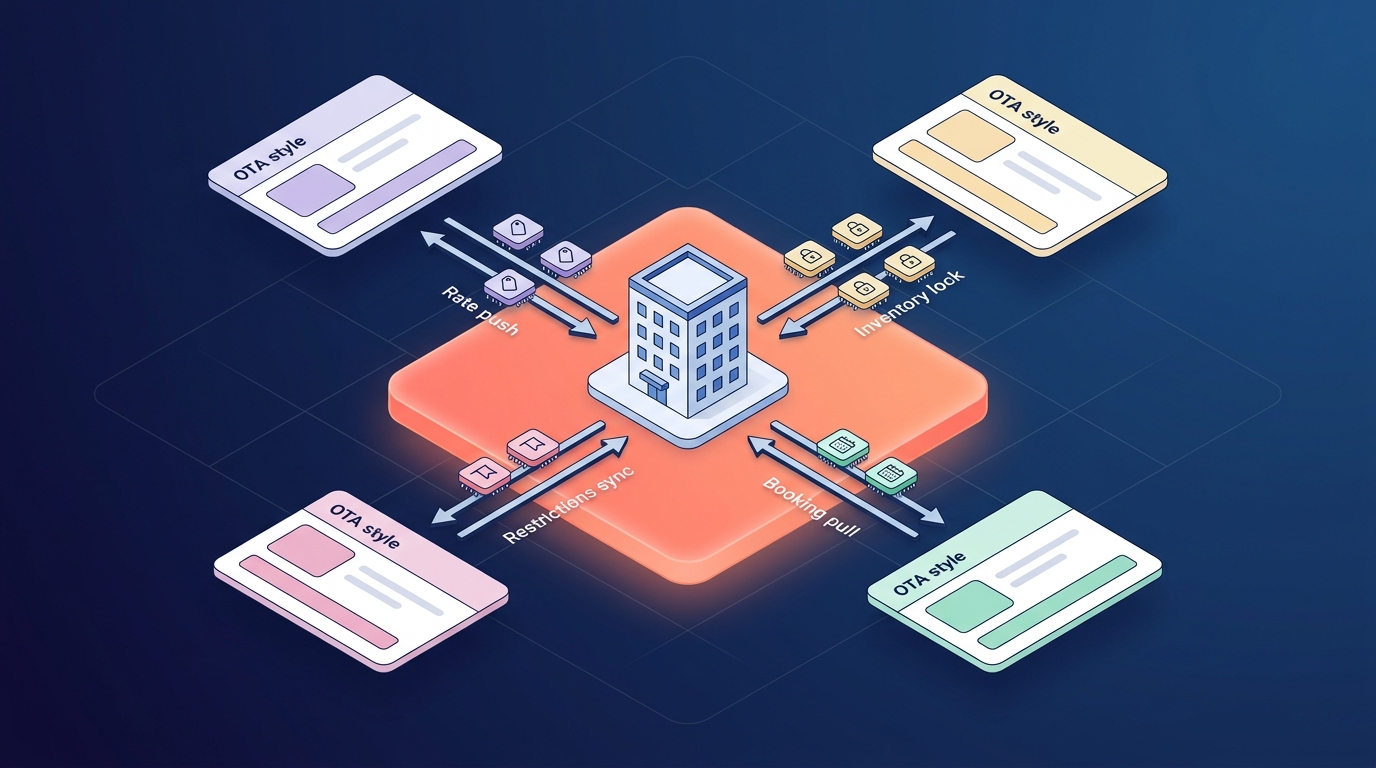
At its core, a channel manager is a real-time two-way sync between your PMS and every OTA you sell on. The good ones handle:
Inventory push — when a room is booked anywhere, every other channel updates within 60 seconds.
Rate push — change a rate in one place, it propagates everywhere with your parity rules applied.
Restrictions push — minimum stay, closed-to-arrival, stop-sell flags.
Reservation pull — the OTA booking lands in your PMS with the guest profile, dates, special requests, and payment method attached.
If you are doing any of those by hand, you are spending hours on what should be milliseconds, and you are exposed to overbookings every time inventory tightens.
The classic mistakes (and how to avoid them)
1. Mapping mismatches
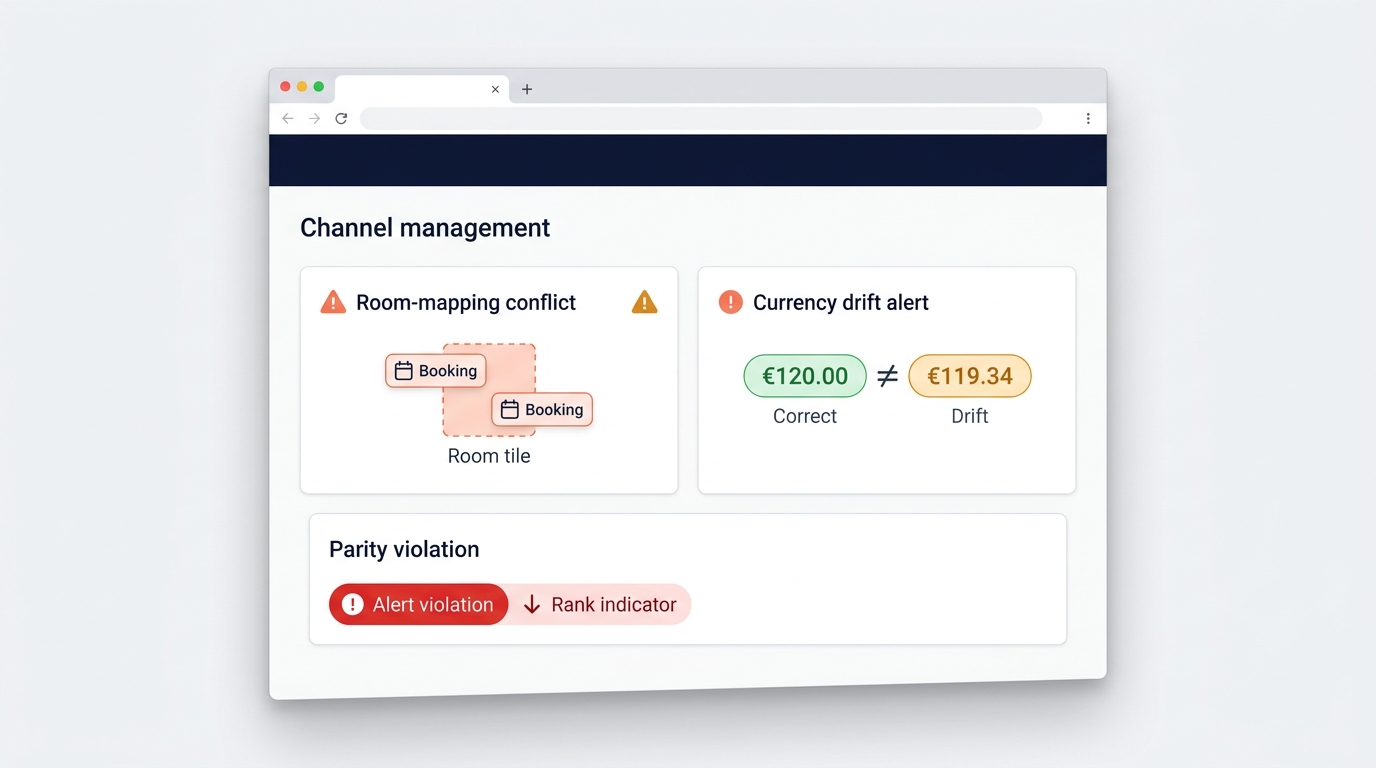
Booking.com calls your room “Deluxe Sea View Double”. Expedia calls it “Premium Double With Sea View”. The channel manager has to know they are the same physical room and the same allocation. If the mapping is wrong, two guests can book the same key for the same night and you find out at check-in. Fix: map every channel during onboarding, test with a fake booking, and re-test every time you add or rename a room type.
2. Currency drift
You set €120 in your PMS. Booking.com displays €120. Expedia displays €119.34 because of a stale FX rate. Guests see the cheaper option, book there, and you absorb the gap. Fix: lock all OTA rates to your PMS currency and let the OTA do the customer-facing conversion at checkout.
3. Parity slips
A staff member changes a Booking-only rate at 3pm. Tonight that rate is lower than your direct site. By 9pm Booking auto-flags it and you lose preferred placement for two weeks. Fix: every rate change goes through the channel manager, never directly into an OTA extranet.
4. Last-room availability
You set the channel manager to stop selling Booking when only one room is left. Then a walk-in books that room at the desk. The channel manager pushes “0 available”, but Booking takes 45 seconds to acknowledge it, and in those 45 seconds it sells the room. Fix: keep a one-room buffer on every channel during peak, or use real channel-manager “last room” alerts and act on them within five minutes.
What you should look for in a stack
If you are evaluating channel managers, optimise for these four things in this order:
Reservation latency. The good ones land a booking in your PMS in under two minutes. Slower means more overbooking risk.
Pre-built mapping templates. Onboarding a new property in 30 minutes vs. three days is entirely about how good the templates are.
Restrictions granularity. If you can only push min-stay per rate plan and not per date, you will lose money on weekend-only rules.
A real audit log. When parity gets flagged, you need to know who changed what and when. Channel managers that hide this fail you exactly when you need them.
Notice that “number of integrated OTAs” is not in the top four. Sixty integrations is impressive marketing. You will use five — Booking, Expedia, Airbnb, Agoda, and one regional — and getting those five right beats supporting a long tail badly.
Where the human still matters
A channel manager handles the plumbing. It does not decide whether to open inventory to Airbnb for the shoulder season, or whether to close Booking during a wedding-night block. Those calls still need a human looking at occupancy, comp-set rates, and event calendars.
Pair the tool with a 15-minute Monday morning ritual: scan the next 60 days, decide where you need to push or pull inventory, and let the channel manager do the rest of the week.
Key takeaways
A channel manager is a two-way real-time sync, not a once-a-day batch.
Most overbookings come from bad room-type mapping, not channel-manager failure.
Hold parity by routing every rate change through the channel manager, never the OTA extranet.
Pick on reservation latency, mapping templates, restriction granularity, and a real audit log — in that order.
Keep a 15-minute Monday ritual for the calls a tool cannot make for you.
Running channel management on spreadsheets and willpower? HotPilot ships with a built-in channel manager and parity monitor — start your trial at hotpilot.ai.