
On 13 October, after a long day at HTIF, we did something we had wanted to do for a while. We invited the people who actually run hotels to Aura by Bamboo in Sofia for our first HotTalks event. A good space, a drink in hand, and time to talk, with nobody in a hurry.
That is the idea behind HotTalks. Not another panel on a forum floor, but the conversations there is never time left for: what is working in your hotel right now, what isn't, and what you would change first if you could.
We opened the evening with a short presentation of HotPilot, and then the conversation turned to the question every hotelier in the room was already asking: how do you plan the future of your hotel when the security situation, guest expectations and the technology you work with are all shifting at once?
Three speakers with very different experience helped us find the answer:
- Prof. Rumen Draganov, director of the Institute for Analysis and Assessment in Tourism
- Teodor Minev, general manager of Voya Beach Resort
- Petar Lozanov, co-founder and CEO of HotPilot
Black Sea: a worry for bookings or a test for a resilient sector?
The security question brought two honest answers, even if they didn't fully agree. And that was exactly what made it valuable.
Teodor Minev offered a valuable perspective from his many years in practice: "Over the last week bookings genuinely dropped," he said, linking the decline to the tension in the Black Sea. In his view the risk isn't limited to travellers' worries: a possible rise in the cost of sea transport and supplies would reach the wider economy and the hotel's own costs.
This is, of course, one hotel's example, not a statistic for the whole sector, and he said so himself. But it raised a question many in the room have run into more than once: how quickly can anxiety around a destination change someone's travel plans?
Prof. Draganov was more optimistic and took the longer view: "My view is that tourism keeps its stability," he said. He reminded us how often the industry has recovered from crises and natural disasters, and pointed to the quick rebound of visitor flows in the Dubai region after the strikes there in recent months. Temporary shocks, he argued, don't necessarily mean a lasting outflow.
Petar Lozanov added a third problem, not so talked about yet but very real: planning. Some hotels are putting off publishing prices for future periods simply because they can't work out what their costs will be.
So one question led to several more. Will guests keep travelling? At what cost will hotels be able to welcome them? Even when demand holds, unpredictable costs make every decision about pricing, staffing and investment harder than it should be.

Petar Lozanov opening the evening with a short presentation of HotPilot
From scepticism to daily work with AI
Teodor Minev's story was familiar to most guests in the room. A year ago he himself was a sceptic. Today he works with AI every day, for summarising information, processing data, market comparisons and pricing support.
"This year artificial intelligence is one of the most loyal and capable 'employees' in my operational work," he said.
And he was clear about where it belongs: "I'm not looking to replace people with AI. I'm looking at how to use AI to free up people's time so they can pay attention to the guests and their overall experience."
Will human judgement remain irreplaceable?
This is where the three of them disagreed most, and where the discussion got most interesting.
Prof. Draganov defended the role of professional competence: it is what checks what the technology suggests. "If you don't have natural intelligence, no artificial intelligence will help you," he said. AI makes mistakes, and someone without knowledge of the field will struggle to notice them. His advice to businesses was simple: keep an eye on the new tools, and never lose your ability to learn and adapt.
Petar Lozanov, however, is less sure how long that will stay true: "For now natural intelligence is still better than artificial, but I'm not sure how long that advantage will last," he said, and he expects AI to take on more and more tasks on its own.
For Teodor Minev the line runs at direct contact with the guest. He would automate even more of the work behind the scenes, but at this stage he would not replace a person with a robot in guest service.

Prof. Rumen Draganov, Teodor Minev and Petar Lozanov on stage
Fear of change has a price too
Not everything comes down to what technology can or cannot do. The important question is how ready we are to change the way we have worked so far.
After many conversations with hoteliers, Petar Lozanov shared that the fact a solution is new is sometimes the very reason people hesitate. Established businesses worry about changing processes they have relied on for years.
He assured us he fully understands that position. But he also pointed to the risk: when fear of the new outweighs the appetite for growth, a hotel can lose ground without noticing, especially on international markets.
Here everyone agreed. Whatever their expectations for the future role of people, technology has to be understood and used. The practical question isn't "AI, yes or no?" It's which tasks can be made better right now, and how teams can be part of that change rather than being presented with a done deal.
Over 370 actions before one booking
Alongside both topics, security and technology, there was one word that kept being brought up, and skilfully so: trust. Before choosing a hotel, a guest needs convincing enough answers about the destination, the conditions and their own needs.
Petar Lozanov gave an example that made the guests think. In one analysis of user behaviour, a single booking involved more than 370 separate actions before the final decision was made. Page views, price checks, conversations, changes of mind.
This is a single case, but it shows how long and tangled the road to a booking can be. Between first interest and the final click, a hotel has countless chances to answer a question, clear up a condition, or leave the guest with a doubt.
"For me the first and most important goal of a booking system is to create trust between the hotel and the guest," he said.
The expectation of an almost instant answer will gradually become a requirement for hotels too. When guests get information from search engines, platforms and AI assistants, the hotel's own channels have to be just as helpful. And competing on price alone squeezes the margin, while a good guest experience starts at the search and the booking.
Prof. Draganov brought it back to the guest as well: whatever is happening in the world, the hotelier has to understand what worries their guests and what they hope for from their stay.
For a hotel, that means working on three things at once: how fast it answers, how reliable its information is, and how personal its attention is. That is how the guest judges whether the promised experience deserves their trust.

The room at Aura by Bamboo
What we showed: from the booking to a long-term relationship with the guest
HotTalks is the series of conversations we aim to build alongside HotPilot, so we opened the evening with a short, honest look at where the platform is going.
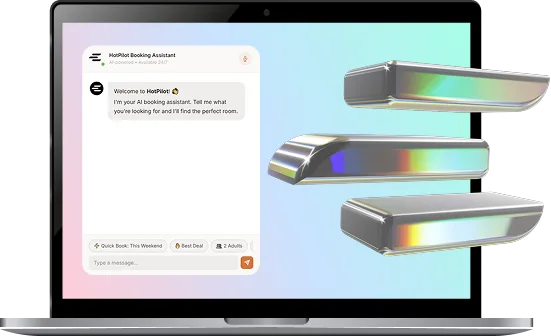
HotPilot is developing into a complete solution for hotel bookings, automation and guest communication: a booking engine, AI chatbots and concierge assistants, integrations with hotel management systems, a channel manager and marketing tools. We're also building our own PMS, and the long-term goal is an "autonomous operating system" for hotels.
Two things we were especially happy to show:
- Natural-language commands. A hotelier can hand an assistant tasks such as changing prices for a given period, creating a booking, sending an email or comparing revenue with the previous season.
- Personal communication. Data on previous stays, preferences and services used helps the hotel make offers that actually fit the guest, by email, SMS or Viber, and keep the relationship going long after the guest has left.
The focus is on independent hotels outside the global chains, priced for their size and potential. "We want these solutions, based not only on artificial intelligence but on knowledge of the industry, to become accessible to the independent hotel," Petar Lozanov said.

The HotPilot team at HotTalks
Thank you, and see you at the next HotTalks event
We left Aura by Bamboo genuinely happy. Thank you to Prof. Rumen Draganov and Teodor Minev for saying what they really think rather than what sounds good on stage. Thank you to everyone who came directly from HTIF, as well as to those who came especially for HotTalks. And of course, our sincere thanks to Aura by Bamboo for the space, the care and the hospitality.
The first-ever HotTalks has already travelled far beyond the room. Economic.bg, Cross.bg, 3eNews, Entrepreneur.bg, TravelNews.bg, „Твоят бизнес“ and others covered our conversation over the past few days.
And we're already preparing our next HotTalks, where we can't wait to talk with some of you. If you run a hotel and want to be part of the conversation, write to us at [email protected]. We'd be glad to have you with us.
Curious about what we showed on stage? Book a demo.