

In Part 1 of this series, we made the case that retention marketing has become the highest-ROI channel in hospitality — and that the infrastructure to execute it properly is now within reach for any property, not just the luxury segment. We covered how to build pre-booking intelligence before a guest ever places a reservation, how to segment guests across behavioural, transactional, and predictive dimensions, and why a unified data platform feeding purpose-built AI models is the foundation everything else depends on.
In this second part, we turn to execution: what it actually looks like to deploy that intelligence in motion — through marketing automation built around momentum, analytics that spots what genuinely drives loyalty, and the compounding advantage that makes the case for starting now.
4. Marketing Automation Built Around Momentum, Not Just Messages
Conventional marketing automation for hotels is built around triggers: “send a pre-arrival email 7 days before check-in; send a post-stay review request 24 hours after check-out.” This is better than nothing, but it mistakes scheduled messages for a communication strategy.
The difference between a message that converts and one that is ignored is almost always timing, relevance, and context. In marketing, there is a concept worth borrowing: the “moment of receptivity” — the precise point when a person is psychologically open to receiving a particular type of message. Most hotel marketing operates on the assumption that all moments are equal. They are not.
Momentum-Driven Communication
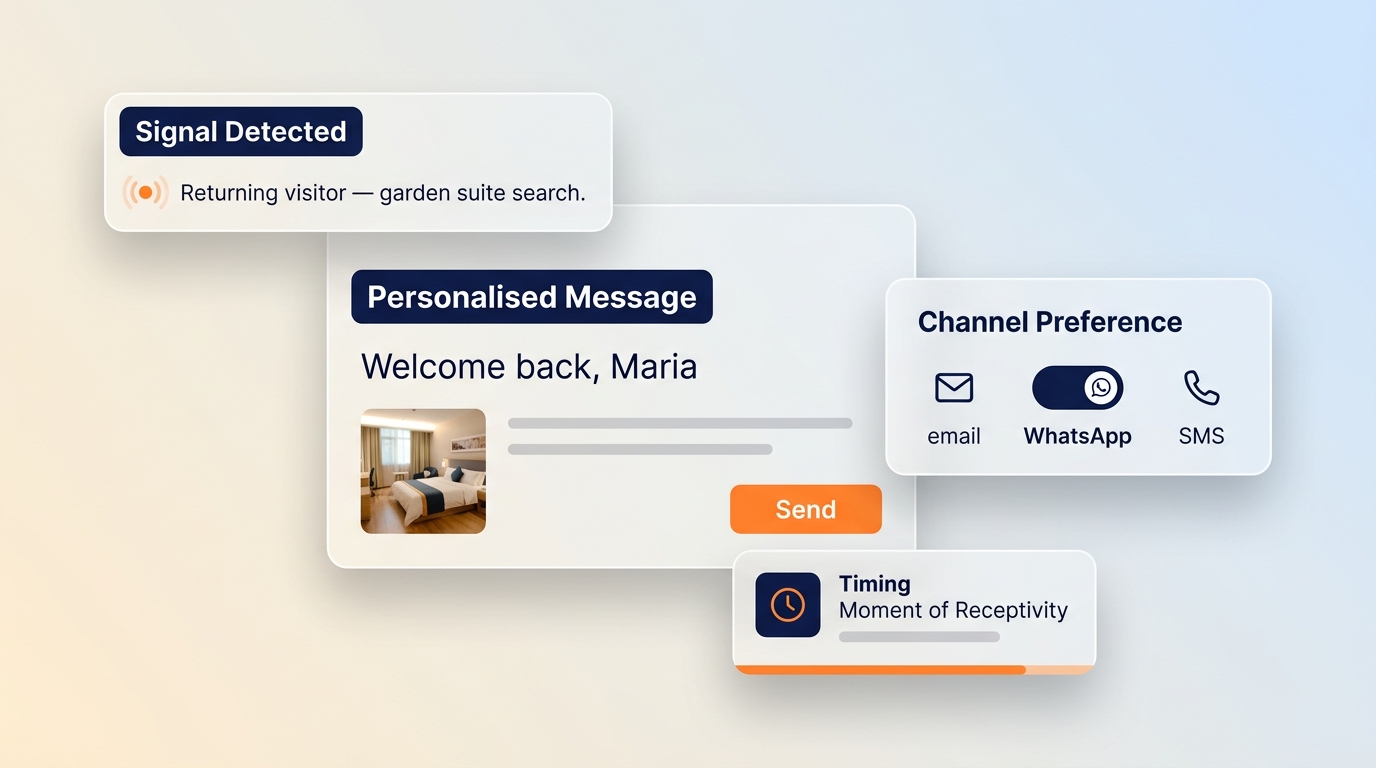
HotPilot’s marketing automation layer is designed around what we call momentum: the detection of signals that indicate a guest is in an active decision-making state, and the delivery of precisely relevant communication at that moment.
Consider these scenarios:
• The returning visitor who has started a new booking session but hasn’t completed it. This is not an abandoned-cart situation that should trigger a generic discount. HotPilot identifies this guest, looks at their previous stay and preferences, and can send a personalised message that acknowledges their return: “Welcome back, Maria. We noticed you were looking at our garden suites for June — your preferred room category from your last visit. Here’s what we’ve added to that experience this season.”
• The anniversary guest who booked last year. HotPilot knows the occasion and the dates. Three months out from the anniversary, before they have started searching, it can surface a personalised offer — not because of a scheduled trigger, but because the predictive model has identified this as a high-conversion rebooking window for this specific guest.
• The guest whose stay satisfaction signals are high mid-stay. A guest who has checked in, ordered room service, visited the spa, and engaged positively with in-stay messaging is in a moment of high emotional connection with the property. This is precisely the right moment to surface an early rebooking offer, a referral incentive, or an upgrade to a category they haven’t experienced.
• The lapsed guest who is back in your destination. Through geo-contextual signals and booking search patterns, HotPilot can identify when a past guest appears to be researching a return trip to your area — even if they haven’t visited your site yet — and ensure your property is visible and personally relevant when they do.
None of these scenarios require you to manually configure complex trigger trees. HotPilot’s automation layer models the guest journey and identifies momentum signals continuously, surfacing opportunities for communication when they are likely to matter most.
The Right Channel at the Right Moment
Momentum-driven communication also means channel intelligence. Some guests are highly responsive to email; others engage almost exclusively through WhatsApp or SMS. Some prefer rich visual content; others want concise, factual messages. HotPilot’s communication layer learns channel preferences from engagement data and adapts delivery accordingly — ensuring your message reaches the guest where they are most likely to act on it.
5. Analytics That Spots Trends, Anomalies, and What Actually Drives Value
In most hotel operations, analytics means looking at last month’s numbers after the fact. Occupancy was up. ADR was down. Direct bookings increased slightly. No one is quite sure why any of these things happened, or what to do differently next month.
This is not analytics. This is historical reporting. And the distance between the two is where most retention marketing opportunities are lost.
Revenue Source Attribution
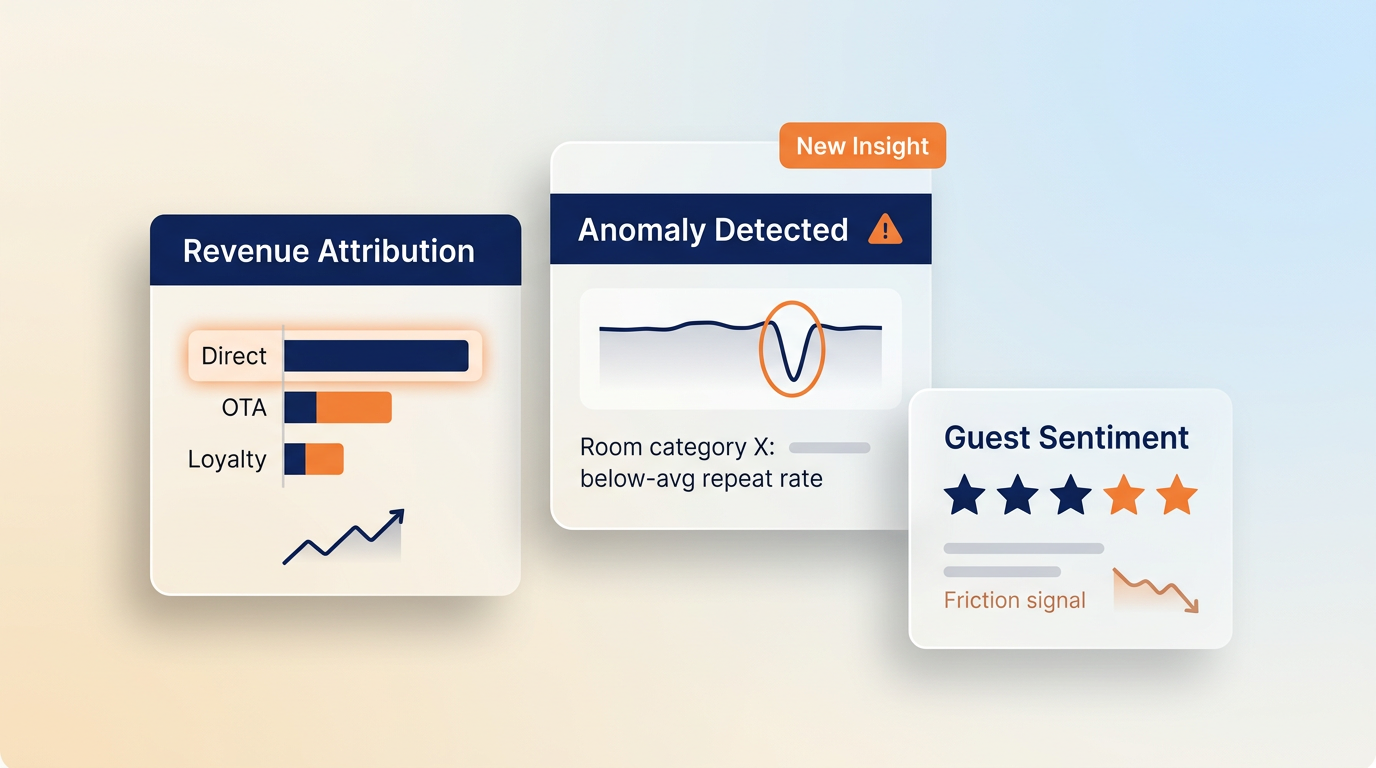
HotPilot’s extended analytics layer is built around a single foundational question: where does revenue actually come from? Not just in terms of booking channel, but in terms of the full acquisition and retention picture.
Which marketing actions are driving new guests who become loyal repeaters? Which campaigns are attracting high-ADR guests who never return? Which OTA segments are generating bookings that would have come direct anyway? Which loyalty touchpoints are genuinely increasing retention versus those that are consumed by guests who would have rebooked regardless?
These questions require a level of attribution depth that most hotel analytics tools don’t attempt. HotPilot’s revenue intelligence framework is designed to answer them, connecting marketing spend and communication actions to guest lifetime value outcomes rather than just conversion events.
Anomaly Detection: The Signal in the Noise
One of the most valuable capabilities of AI-powered analytics is anomaly detection: the ability to surface patterns that deviate from established norms, before a human would notice them.
Consider what anomaly detection makes visible in a hospitality context:
• A specific room category is generating consistently lower post-stay satisfaction scores than comparable rooms — the signal is weak enough that it would never appear in a manual review, but strong enough that over six months it is suppressing repeat bookings from that segment.
• A marketing automation sequence that was designed to drive upsell offers is actually correlating with a slight increase in post-stay negative reviews, because the communication timing is perceived as pushy by a specific guest segment.
• A particular booking source is delivering guests who look valuable on arrival (high ADR, long stays) but who almost never return and consistently leave below-average reviews. The economics of this channel look positive in a first-booking model but deeply negative in a lifetime value model.
• A new local event or seasonal pattern is driving an unusual concentration of a specific guest type — an opportunity for targeted outreach that a calendar-based system would miss.
HotPilot’s analytics layer monitors these signals continuously and surfaces them as actionable insights rather than raw data points. The distinction matters: a hotelier should not have to be a data scientist to benefit from anomaly detection.
What Annoys Customers Is As Valuable As What Delights Them
One of the most commercially underappreciated forms of retention intelligence is negative signal analysis: understanding not just what drives loyalty, but what drives defection.
Common sources of guest friction that erode retention are rarely found in standard metrics. They live in the spaces between: the check-in experience that was fine but slightly impersonal; the pre-arrival email that arrived at an inconvenient time; the upsell offer that felt tone-deaf to the guest’s occasion; the in-stay request that was resolved correctly but not proactively.
HotPilot’s analytics framework is designed to surface these friction signals by connecting post-stay sentiment data, in-stay interaction patterns, and communication engagement signals into a coherent picture of what the experience of staying at your property actually feels like to different guest segments. The goal is not to produce a satisfaction score — it is to identify the specific moments where the gap between expectation and experience is widest, and close them systematically.
6. The Compounding Effect: Why Retention Marketing Gets Better Over Time
There is one more argument for building retention marketing capability now, before the AI era reaches full maturity in hospitality: the compounding data advantage.
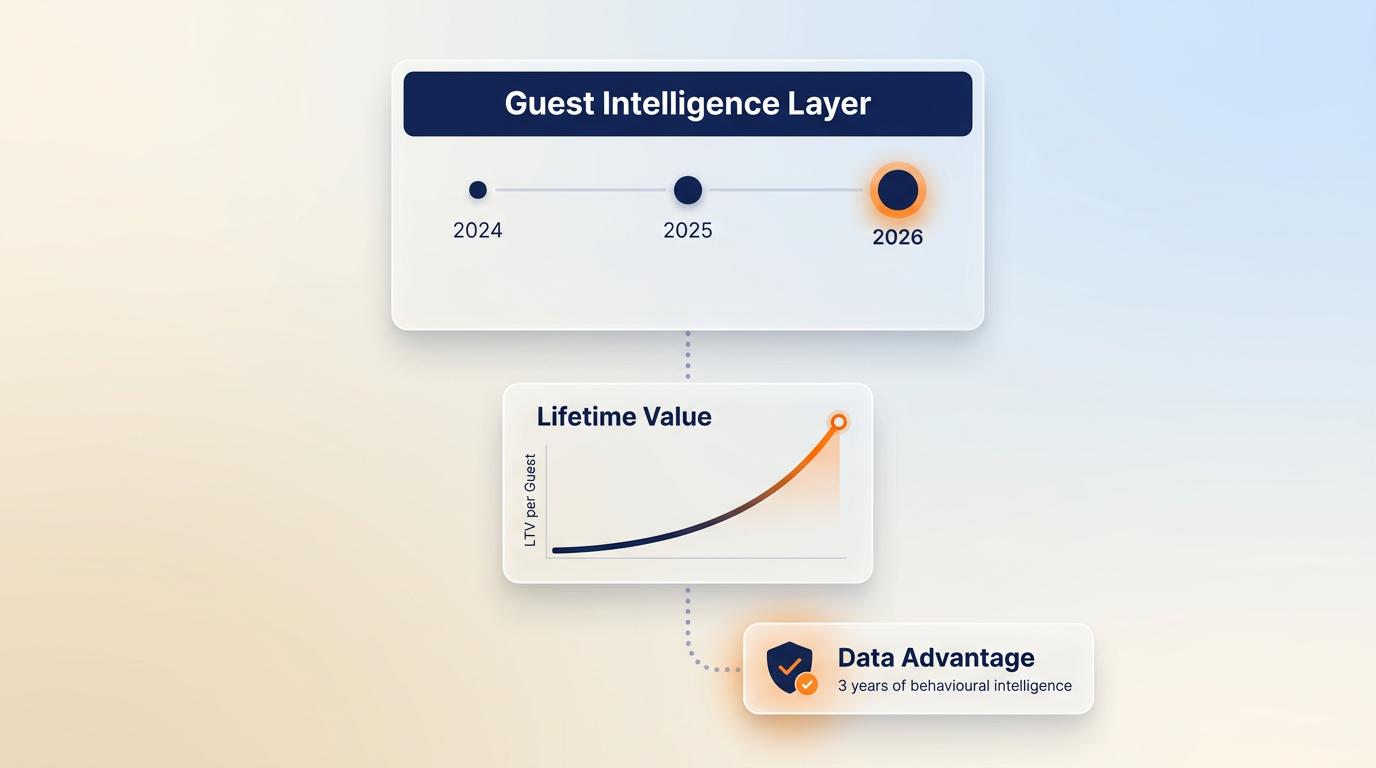
Every interaction a guest has with your property — every booking, every pre-arrival conversation, every ancillary purchase, every post-stay message they open or ignore — makes the intelligence layer richer and more accurate. Properties that start building this layer now will, in three years, have a guest intelligence advantage over competitors that is extremely difficult to close.
An AI model trained on five years of your property’s guest data, communication patterns, and outcomes will generate recommendations that are qualitatively different from one trained on six months of data. The hotels that begin this compounding process in 2025 and 2026 will have a structural advantage in the 2028 and 2030 competitive landscape that is not just about technology — it is about institutional knowledge, encoded at scale.
“Retention marketing is not just a channel strategy. In the AI era, it is a compounding asset. Every guest interaction adds value not just to that relationship, but to the intelligence that makes every future relationship better.”
Conclusion: The Hotel That Knows You
There is a moment every traveller knows — the rare occasion when a hotel seems to understand exactly who you are. Where the communication doesn’t feel like a template. Where the offer is genuinely relevant to your trip. Where the experience reflects preferences you may not have consciously articulated, but which feel unmistakably right.
That feeling has historically been the exclusive province of small, intensely personal operations where the owner knows every guest by name, or luxury properties with resources to maintain manual relationship intelligence at scale.
AI has democratised it. The technology to know your guests — deeply, individually, in a way that makes every communication feel like it was written specifically for them — is no longer the preserve of the few. It is available to any property willing to invest in a platform that takes guest intelligence seriously.
HotPilot was built on the belief that the future of hotel revenue is not in the next acquisition channel — it is in the guest standing in your lobby right now, and every version of that guest who could come back in the years ahead.
The question is not whether AI-powered retention marketing works. The evidence on that is unambiguous. The question is which properties will build that capability first.
About HotPilot
HotPilot is a next-generation hotel booking and property management platform built for conversion, retention, and intelligent growth. Combining conversational commerce, AI-powered analytics, and automated marketing tools, HotPilot helps accommodation providers of all sizes build the guest relationships that drive long-term revenue.