

A guest who has reached your payment screen is not shopping any more. They have compared you against three other properties, decided they like your rooms, chosen dates, and started typing their name. If they leave at that point, they did not reject your hotel. Something in the last ninety seconds stopped them.
That distinction matters, because it changes what you fix. Hotel booking engine conversion is rarely improved by better photography or a louder discount. It is improved by removing specific obstacles from the final few steps, in the order that the obstacles actually cost you money.
Start with what the guest can see at the moment they stop
Open your own booking flow on your own phone, on mobile data rather than the office Wi-Fi, and book a real room for a real date. Do not use a test property. Do not use the laptop you built the site on. The point is to meet the flow the way a guest meets it — cold, slightly impatient, on a screen a third the size of yours.
Most operators find something within two minutes. The total that appears at step three is not the total at step one. A field rejects a perfectly valid phone number because it wants a country code it never asked for. The date picker opens on the current month when the guest is booking for August.
None of these are design opinions. They are mechanical faults, and each one has a name.
The four obstacles that account for most abandonment
A price that changes after the guest has accepted it. If the room shows at one figure and the payment screen shows another — because of tourist tax, a cleaning fee, a card surcharge — the guest does not experience this as a detail. They experience it as the moment they stopped trusting the number. Show the full, final total as early as you can compute it, and label every component. A tax the guest expected is not friction. A tax that appears at the end is.
An account wall. Requiring registration before payment adds work in exchange for nothing the guest wanted. They came to book a room, not to join something. Guest accounts are genuinely useful — for returning guests, for managing a stay — but they belong after the booking, offered, not before it, demanded.
A payment method the guest does not use. This is the quietest killer, because it is invisible in your analytics: the guest simply leaves. Payment habits are strongly regional. A flow that converts well for German guests can fail for the same room sold to a Bulgarian or Greek one. If you take international bookings, the question is not whether you accept cards — it is whether you accept the card and the method that market actually reaches for.
A mobile experience built on a desktop. Small tap targets, validation messages hidden above the fold, a keyboard that covers the field being typed into, a back button that discards everything. On a laptop these are irritations. On a phone, held one-handed at a train station, they end the booking.
Read the drop-off before you redesign anything
You do not need a large analytics programme to see where bookings stop. You need the count of guests who reach each step: search, room selection, guest details, payment, confirmation. The step with the steepest fall is the one to work on, and it is frequently not the step people assume.
Two cautions. First, a fall between search and room selection is usually not a fault — plenty of people look without intending to book. The falls worth chasing are the ones deep in the flow, where intent was already high. Second, be careful comparing your rate to a published industry benchmark. Those figures mix property types, seasons and markets so different that the comparison tells you nothing actionable about your own funnel. Your own number last month is the only benchmark that means anything.
When you do evaluate tools, judge a booking engine for direct reservations on how few steps it needs and how honestly it shows the total — not on how many features appear in the comparison table.
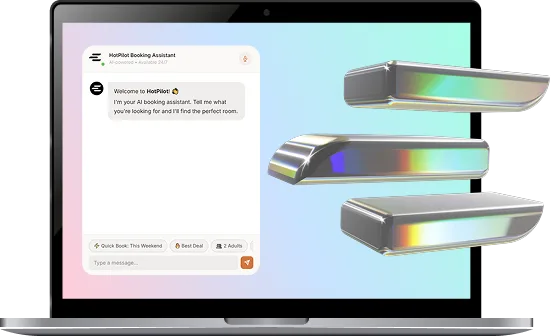
None of this needs a new system to diagnose — but once you know which step is losing people, you need something that shows it to you every week rather than once a year. That is the part we built HotPilot to do, and it is the sort of thing worth seeing against your own booking flow rather than a demo property.

Fix the flow before you spend on traffic
There is a sequencing mistake that is expensive and very common: paying for more visitors to a flow that loses them. Advertising multiplies whatever your booking flow already does. If one in twenty visitors completes, doubling the traffic doubles both the bookings and the abandonment, at the cost of the second batch of clicks.
Working on the flow first is unglamorous and has no launch date, but it changes the economics of every campaign that follows. It also changes nothing about your rates, which is worth saying plainly: none of this requires discounting.
What not to touch
Some friction earns its place. A cancellation policy stated clearly before payment will lose you a few bookings and save you a great many disputes. A deposit requirement on a long stay is doing a job. A question about arrival time helps housekeeping plan the day.
The test is not whether a step slows the guest down. It is whether the step exists for the guest’s benefit or only for yours. Removing a required field that nobody reads is progress. Removing your cancellation terms is not.
Equally, resist rebuilding everything at once. Change one thing, watch it for a fortnight, keep it or revert it. A single well-understood change beats a redesign that moves the number for reasons nobody can identify afterwards.
Let’s sum up!
- A guest who abandons at payment has already chosen your hotel — the obstacle is in the last few steps, not in your rooms or your rates.
- Book your own hotel on your own phone, on mobile data. Most operators find a real fault within two minutes.
- The recurring four: a total that changes late, a forced account, a missing local payment method, and a flow designed on a desktop.
- Read the drop-off per step before redesigning, and compare only against your own previous months — published benchmarks mix too many property types to be useful.
- Fix the flow before buying more traffic; advertising multiplies whatever your checkout already does, in both directions.
- Keep the friction that protects you. Clear cancellation terms cost a few bookings and prevent far more disputes.
If you want a second pair of eyes on where your own checkout loses people, we will happily go through it with you — book a HotPilot demo and bring your worst-performing month.