
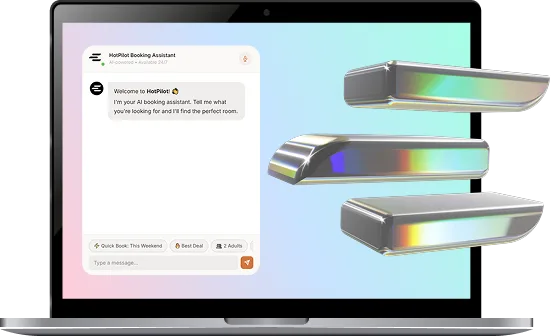

Hotel chatbots have earned a bad reputation, and they earned it honestly. Most of them answer “what time is breakfast?” and surrender on anything harder. A real AI concierge is a different category — it qualifies the guest, holds a real conversation in their language, and either takes the booking itself or hands a warm lead to the front desk. Here is what separates the two, and what to ask for if you are evaluating one.
The chatbot–concierge gap
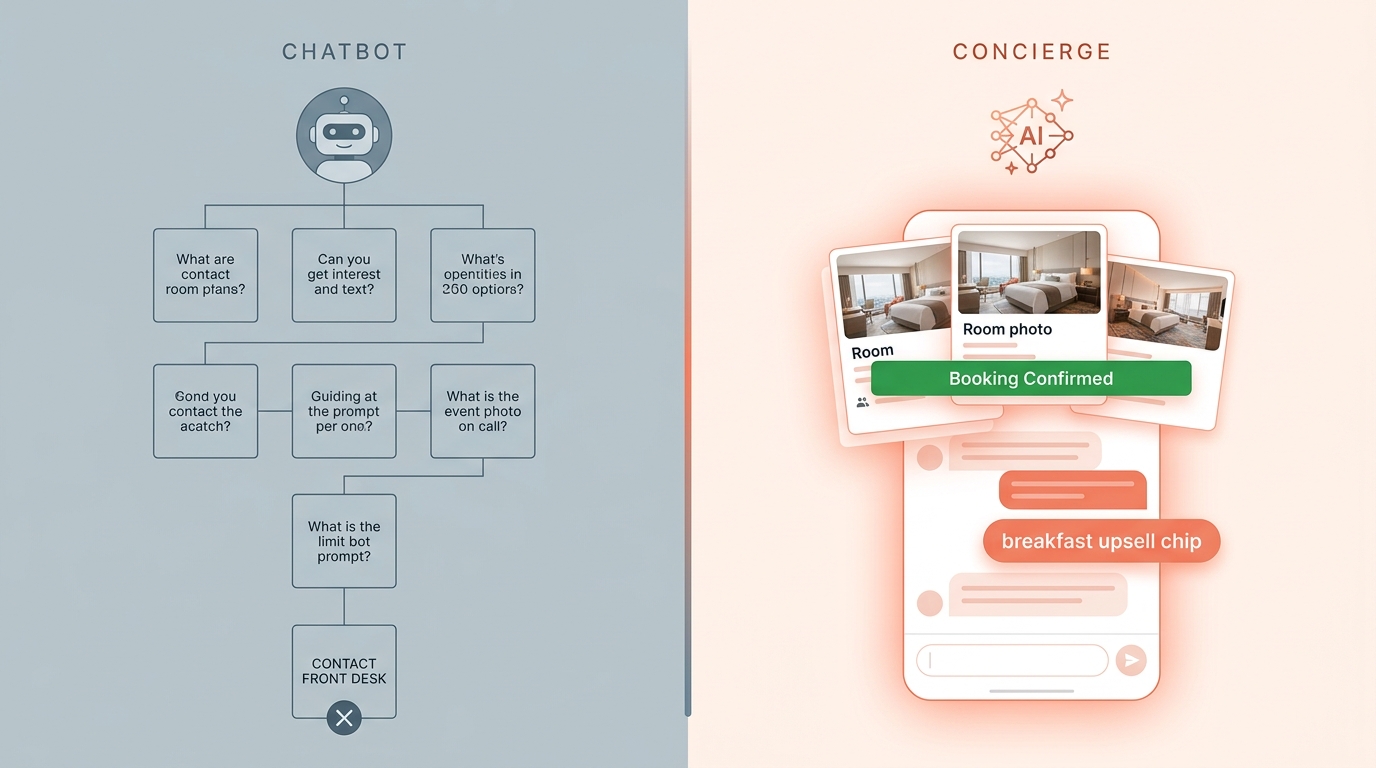
The classic hotel chatbot is a decision tree dressed up as a conversation. Guest types “do you have a pool?” — it returns a hard-coded answer. Guest types “is it heated in November?” — it falls back to “Please contact our front desk.” It is a deflection tool.
A concierge is the opposite. It is built to convert. The guest types “I am looking for two adjacent rooms for a family of four in early August” — and the concierge checks availability, proposes two options with photos, surfaces the family rate, and offers to add breakfast and parking. By the time the guest asks a clarifying question, half the booking is already in the basket.
The difference is not the model. It is what the model is connected to.
Three things a real concierge has to do
1. Read your inventory in real time
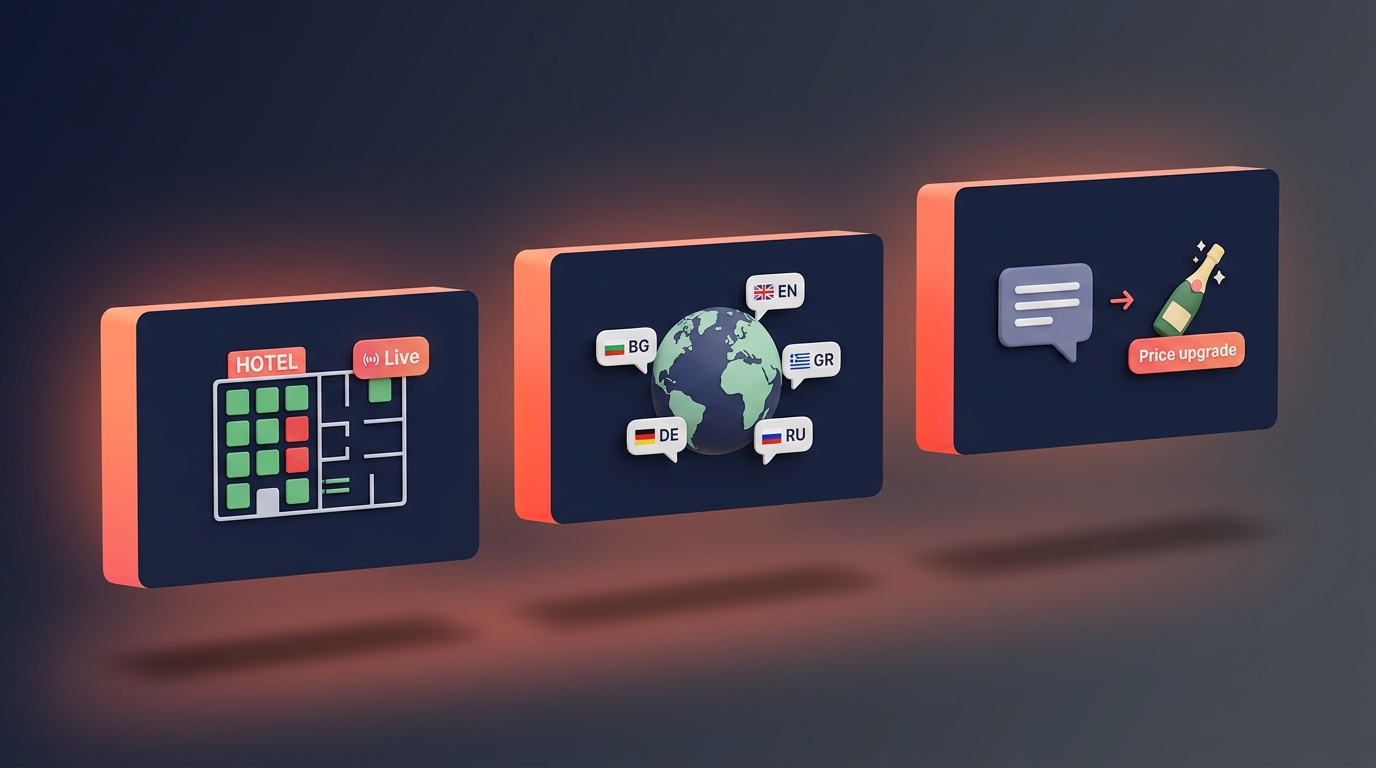
If the concierge does not see your live room availability, rates, and restrictions, it cannot quote and cannot book. It can only deflect. A real concierge connects to the PMS or booking engine via a service-layer API and refreshes on every turn of the conversation. No “let me check with reception”.
2. Speak the guest’s language — naturally
Hotels in Sofia, Plovdiv, or Burgas serve guests from at least eight markets in a single summer. A concierge that only handles English loses every booking that started in Bulgarian, German, Greek, or Russian. The bar for “speaking the language” is also higher than five years ago. Stilted phrases lose guests. The best concierge platforms today deploy on top of multilingual frontier models — Claude, GPT-4o, or similar — and tune them on your hotel’s specific language: room names, policies, neighbourhood lore.
3. Upsell without feeling pushy
There is a reliable upsell sequence that does not break the conversation: confirm the booking the guest asked about, then ask one open question (“Will you arrive late?” or “Is this for a special occasion?”), then offer a relevant add-on. Late-arrival flow opens a paid late-check-in upgrade. “Anniversary” opens a champagne package. The trick is to ask the question and let the guest tell you what to sell, instead of guessing.
What this looks like in numbers
Independent hotels that move from a deflection bot to a real concierge see:
+8–14% direct conversion rate on the property site — chat is the difference between a window-shopper and a guest who books.
+3–6% ancillary revenue per booking from in-conversation upsells.
-30–45% inbound email + WhatsApp volume at the front desk, because most “do you have…?” questions stop at the chat.
Those are not aspirational ranges. They are what hotels actually report in the first three months, when the integration is right.
Where to be careful
A concierge is a public face of your brand. Two things you should never skip:
Hand-off rules. Define explicitly which conversations escalate to a human (group bookings over X rooms, complaints, anything involving health or safety). The concierge should hand off cleanly, with context.
Transparency. Guests should know they are talking to an AI. Lying about it loses trust the moment the guest notices, and they always notice.
Done right, the concierge becomes the lowest-effort, highest-margin channel on your property. Done wrong, it ranks below a 2003-era contact form. The difference is integration discipline and a model that actually speaks human.
Key takeaways
A chatbot deflects. A concierge converts. The difference is connection to live inventory.
Real-time PMS/booking-engine integration is non-negotiable.
Native multilingual conversation is now table stakes, not a premium feature.
Upsell with a question, not a pitch — guests tell you what to sell.
Always be transparent that the guest is talking to an AI. Always have a clean hand-off.
HotPilot’s AI Concierge plugs into your existing booking engine and speaks six languages out of the box. Try it at hotpilot.ai.


