
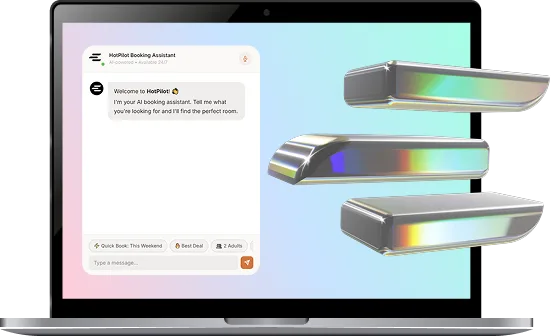

We set out to fix something that was quietly making our work impossible.
I want to tell you how HotPilot was born. Not the pitch version — not the one that starts with “we identified a market gap.” The real version. The one that starts with frustration, a lot of wasted hours, and a conversation over coffee where Hristo and I looked at each other and said, almost simultaneously: “Wait. You have this problem too?”
That moment of recognition is where this company actually started.
Two Worlds, One Industry, One Broken Toolbox
I’ve spent most of my career somewhere at the intersection of travel, ecommerce, and digital marketing. I know what it feels like to have the right data, the right funnels, the right infrastructure. I know what it looks like when a business is genuinely instrumented — when you can follow a customer from the first impression to the conversion and back again, when your attribution model is telling you something real, when your AI-assisted campaigns are learning and optimising and actually improving over time.
That experience is what made what I was seeing in hospitality so difficult to accept.
Hristo came from a different angle but arrived at the same place. He had spent years deep inside the hospitality industry — building software solutions for hotels, helping properties solve their marketing challenges, working with the systems that the industry actually runs on. He knew the landscape from the inside. He knew every major platform, every workaround, every limitation that hoteliers had learned to accept as just “the way things are.”
When we first started working together on other projects — before HotPilot existed even as an idea — we were both spending an uncomfortable amount of energy fighting the same invisible enemy: the profound inadequacy of the technology that the hospitality industry runs on.
“Every other industry I had worked in had tools that talked to each other, shared data cleanly, and gave you the visibility you needed to make good decisions. Hotels were operating with a patchwork of systems that seemed actively designed to prevent that.”

The Moment Everything Crystallised

There was a specific moment when the frustration became something more purposeful.
Hristo and his wife-to-be were deep in a project trying to optimise paid acquisition for a hotel. Nothing exotic — just the basic, necessary work of understanding which campaigns were driving bookings and at what cost. Standard stuff in ecommerce. Genuinely complicated, as it turned out, in hotels.
The problem was the booking engine. One of the most widely used platforms in the Balkans. A system that thousands of properties relied on. They needed conversion data — clean, reliable, matchable against what they were seeing in Meta Business Manager and Google. The kind of data that in any other vertical you would have in an afternoon.
What followed was months. Months of back-and-forth with the platform’s technical team. Months of workarounds, partial solutions, data feeds that were either incomplete, delayed, or simply inconsistent with what the ad platforms were reporting. They have tried every approach they could think of. They were patient. They escalated. They documented everything.
Hristo told me once:
The data never got there. After all that time, the conversion signals we could extract from the booking engine couldn’t get even close to what Meta and Google were seeing. Our campaigns were running blind. We were optimising based on noise.
The cost of every conversion was climbing, and they had no reliable way to understand why, or what to do about it.
Hristo: “This wasn’t a small technical inconvenience. This was a fundamental failure of infrastructure that was costing real money and making intelligent marketing practically impossible.”
 The Coffee That Changed Everything
Hristo told me the story. Not as a pitch. Just venting — sharing the exhaustion of fighting a problem that should not exist.
I wasn’t surprised. I probably was looking like someone who had been waiting for someone else to finally say it out loud.
I had my own version of the same story. Different hotels, different platforms, different specific failures — but the same fundamental shape. The systems didn’t talk to each other. Attribution was guesswork. Building any kind of proper marketing funnel felt like trying to construct something precise out of materials that refused to fit together. And nobody in the industry seemed to be treating this as the serious, solvable problem it was.
We started listing everything: no proper multi-touch attribution. No reliable behavioural data from booking engines. PMS systems locked in their own silos. Email tools disconnected from booking behaviour. Analytics that told you what happened but never why, and certainly never what to do next.
Then I said to Hristo something that shifted the whole conversation.
“We’re talking about attribution and conversion data. But nobody’s even addressing the real elephant in the room.”
The Elephant in the Room
In ecommerce, conversational commerce driven by AI had been transforming customer acquisition and retention for years. Not as an experiment — as a mainstream capability. The technology to have a genuinely intelligent, contextual, personalised conversation with a customer at the moment of purchase decision had arrived, and the best ecommerce operations were using it.
Hotels had nothing comparable. Not even close. The “chat” tools that existed on most hotel websites were either static FAQ bots with the intelligence of a 2010 automated phone menu, or live chat widgets that someone on the front desk might answer when they got around to it.
And here’s what struck us: of all the industries where conversational AI should have the most impact, hospitality is arguably at the top of the list. Because the hotel booking decision is not a simple transaction. It is an extended, emotionally loaded process that involves research, comparison, doubt, aspiration, and often a very specific set of needs and desires that a traveller struggles to express through a standard booking form.

The average traveller takes 28 days from first inspiration to completed booking. During that period they visit an average of 38 websites, conduct multiple searches across different platforms, return to the same properties multiple times, and make a decision that is ultimately driven by a complex mix of practical and emotional factors.
An intelligent conversation — one that understands context, remembers preferences, answers nuanced questions about the property, and guides the guest toward the right room at the right rate — can compress that journey dramatically. It can convert the visitor who would otherwise leave and book on an OTA. It can capture the guest who had a specific question that the booking form couldn’t answer.
None of this was happening. The industry was leaving an enormous amount of value on the table, and the reason wasn’t lack of demand — it was lack of infrastructure.
“The hotel booking decision is one of the most complex consumer journeys that exists. And the industry was trying to navigate it with tools built for a world that no longer exists.” 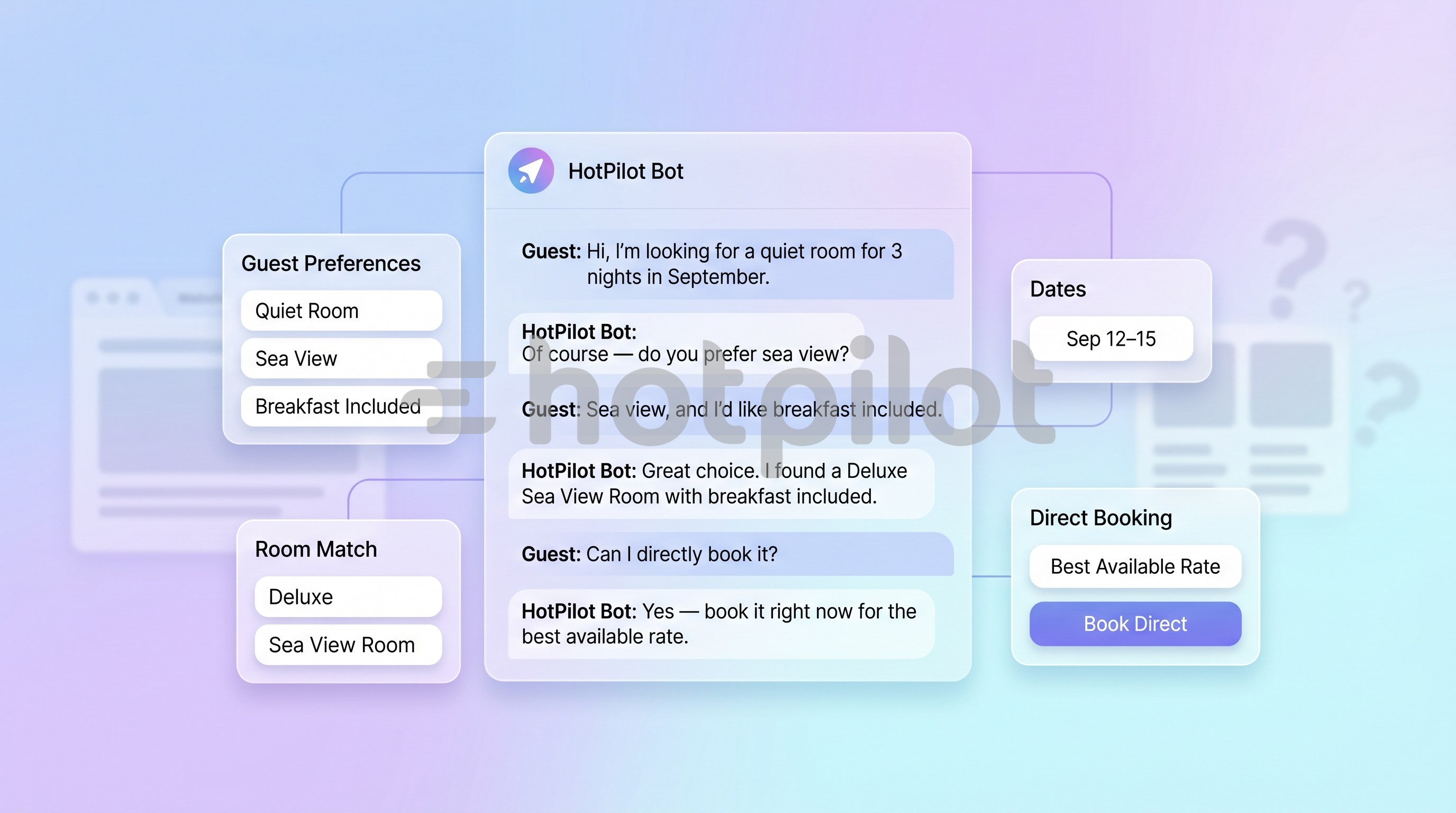
 Let’s Just Test It
We didn’t write a business plan. We didn’t do a formal market sizing exercise. We did what I think is the most honest thing you can do when you believe you’ve identified a real problem: we went and talked to the people who had it.
Three hotels first. Then five. Properties we already had relationships with, owners and managers who trusted us enough to be honest about what was and wasn’t working. We walked them through what we were thinking. We showed them what the infrastructure could look like. We described what the data picture could be.
The reaction was not what I had cautiously hoped for. It was bigger than that.
One owner — a woman who had been running a boutique property for over a decade, who had seen every software vendor promise to solve her problems and deliver something halfway — sat quietly for a moment after we finished. Then she said: “How soon can you start? And is there any way I can invest in this?”
She was not the only one. Several of the first properties we spoke to didn’t just want to use the platform. They wanted to be part of building it. That’s not a typical response to a software demo. That’s a response to something that touches a real, deep, long-standing pain.
We went back to ten more hotels. Then another ten. The conversations were different in their details and identical in their shape. The frustration was universal. The appetite for something better was real and urgent. And the validation we were getting wasn’t polite encouragement — it was the kind of feedback that makes you feel the weight of responsibility.
What We Are Actually Building
HotPilot is not, at its core, a booking engine or a PMS or a CRM. It is an attempt to give the hospitality industry the infrastructure that every other consumer industry has had for years — and to do it in a way that is built from the ground up for how hotels actually work and how travellers actually make decisions.
That means clean, reliable data that talks to your ad platforms without months of painful integration work. It means attribution that actually reflects reality. It means a conversational layer that can have a genuinely intelligent exchange with a prospective guest at the moment they are making their decision. It means analytics that tells you not just what happened, but what it means and what to do next.
It means, in short, that the boutique hotel in a beautiful corner of the world that is fighting with one hand behind its back against OTA algorithms and rising acquisition costs finally has tools that are worthy of the product it is selling.
Hristo and I have both spent enough years in this industry to know that the problem is real and the gap is wide. We’ve also spent enough time in ecommerce and digital marketing to know that it is solvable — that the technology exists, that the approaches are proven, and that what’s been missing is someone willing to build it properly for hospitality.
That’s what we’re doing. The story is still being written. But it started, as the best stories do, with two people who cared enough about a problem to stop complaining about it and start doing something about it instead.
About HotPilot
HotPilot is a next-generation hotel booking and property management platform built for conversion, retention, and intelligent growth. Combining conversational commerce, AI-powered analytics, and automated marketing tools, HotPilot gives accommodation providers of all sizes the infrastructure to compete and win in the modern travel landscape.
hotpilot.ai


